
Guide
UC Personal Insight Questions: How to Choose Your 4 and Write Answers Readers Remember
Shourya C. arrived with awards.
He was a senior carrying a 3.1 unweighted UC GPA. His early drafts carried something heavier: paragraph after paragraph of self-praise, polishing trophies until the person disappeared. The writing sounded impressive. It said very little.
His counselor scrapped the approach and rebuilt it around community impact. Achievements stayed as platforms. The stories moved elsewhere, to failure and iterative design, to pressure inside an immigrant family, to a genuine character flaw he had been editing out. Then came the assignment that changed the essays: write 50 variations of his core community issue. Fifty. Most were disposable. A few were honest in a way the first drafts never approached. His theater background and visual storytelling became the voice on the page.
He worked that rebuild in weekly workshops for six weeks.
That process holds the whole method. Find the material first. Choose prompts second.
Prompts Are Containers
UC states the rule plainly: "All questions are equal. All are given equal consideration in the application review process, which means there is no advantage or disadvantage to choosing certain questions over others."
The eight questions are containers, and readers judge what a student pours into them.
Most students pick the four prompts that sound most impressive and squeeze their lives into those shapes. Four squeezed answers tend to say one thing four ways. Shourya C. ran the stronger sequence: inventory the experiences that changed him, then match that inventory to prompts displaying four different sides of him.
First, Respect the Format
For first-year applicants, the format is fixed. Applicants answer 4 of 8 questions. Each response has a maximum of 350 words. UC publishes no minimum. The same four answers go to every campus selected, across all nine undergraduate campuses.
Activities allow up to 20 entries across 6 categories, with 350 characters for a main description. An answer that spends 200 words arriving at its point has spent its budget on arrival. UC instructs applicants to skip letters of recommendation, with one exception: some campuses or majors may request letters as part of a supplemental application review. UC also offers no interview in first-year review. The writing carries unusual weight, with a limit UC itself sets: "An admission decision will not be based on this section alone." The Personal Insight Questions are the main place a reader hears a student think in their own sentences; Additional Comments provides a second written space. Our companion walkthrough, the UC application field by field, maps the rest of the file.
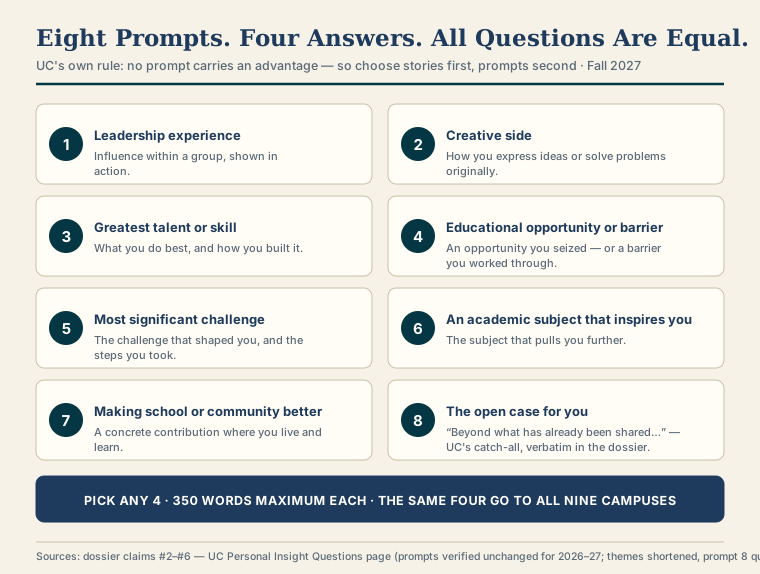
The eight prompts, unchanged for the 2026–27 cycle, cover these themes: 1) leadership; 2) creative side; 3) greatest talent or skill; 4) educational opportunity or barrier; 5) most significant challenge; 6) an academic subject that inspires you; 7) making school or community better; and 8) the open prompt, in UC's wording: "Beyond what has already been shared in your application, what do you believe makes you a strong candidate for admissions to the University of California?"
Choose Stories Before You Choose Prompts
Start the inventory on a blank page:
- An experience that changed how you think or spend your time
- A responsibility most students never carry, at work, at home, or in a community
- A project, failure, or obsession you returned to after the first attempt failed
- A community you belong to, paired with what you did inside it
Most students stop at the first acceptable story. Push past acceptable.
Now match inventory to prompts. Two answers drawing on the same team, the same competition, the same season waste a slot. The set needs range: intellectual curiosity in one, responsibility in another, creative work in a third, community impact in a fourth.
Name the moment. Give the number when a number exists and you can defend it: hours worked, people trained, dollars raised, seasons completed. Pair that discipline with how to write activity descriptions that quantify impact; a PIQ and an activity entry on the same work should deepen each other.
Revision Is Where Answers Become Memorable
Nizmund M. shows what serious revision looks like. A senior with a 4.4 GPA, he was aiming at public health and direct-entry nursing programs, with overlapping, unfocused essays. His father had died suddenly during his 9th-grade year. He was being raised by a single mother. The material was powerful. The structure buried it.
In one session, his counselor restructured the writing end to end. The healthcare essay would connect his father's health experience to broader healthcare systems, open on his mother's proactive caregiving, and close on securing support services for his younger sibling, the bridge into his nonprofit work. Two volleyball essays became one narrative about cultural identity, built from national and international club play, including play with a Filipino team. A distracting childhood reference came out. The essay opened instead on the first signs that his younger sibling needed support.
Study the moves. Merge duplicates. Reflection carries the final third of a strong answer: what changed, what the student does differently now. Plot summary alone leaves a reader informed and unmoved.
Applicants write in their own words, and UC excludes grammar, spelling, and sentence structure from the evaluation, while proofreading for clarity still counts. Write like a thoughtful seventeen-year-old. Students applying to private colleges alongside UC face a different form, covered in Common App personal statement mistakes and our case for why college essays carry this much weight.
UC reads applicants inside their circumstances: courses offered, job hours, family obligations. UC considers no SAT or ACT score for admission or scholarships — the policy behind our guide to when to submit or withhold test scores for other systems. California families file on two calendars: our guide to FAFSA mistakes that cost families money covers the FAFSA and Cal Grant deadlines running alongside the UC window.
A Work-Back Plan for November 30, 2026
The UC filing period runs October 1 through November 30, 2026, a Monday. The phases below are Meridian's plan, sequenced backward from that date. Readers in the final fortnight start at the set-check and fresh-eyes phases; the full sequence stands for juniors and the next cycle.
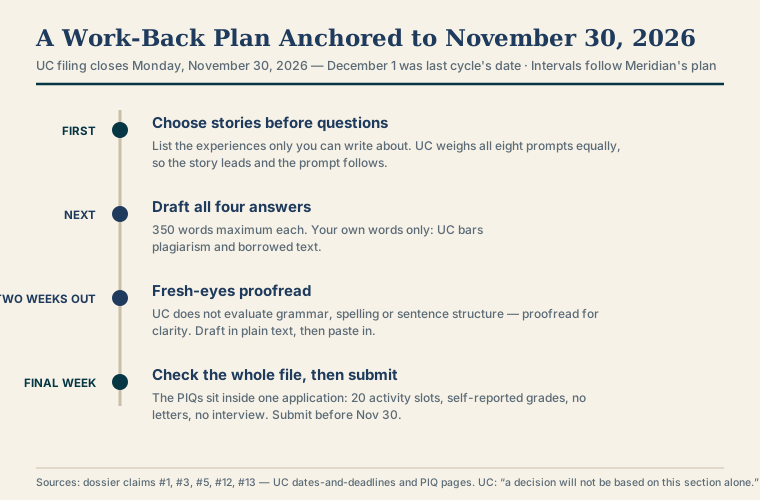
- First: Build the story inventory. Match four stories to four prompts. Draft all four roughly.
- Next: Cut each answer to 350 words or fewer. Read each aloud; rewrite any sentence you stumble over.
- Two weeks out: Check the set as a set: four answers, four kinds of ground, one concrete detail only the student could supply in each.
- Final week: Fresh-eyes pass for clarity. Submit ahead of the final evening.
The Tactical Playbook
- List stories first. Open the prompt list second.
- Select four prompts that display four different sides of the student.
- Cap every answer at 350 words; hold the set to 1,400 words total.
- Open each answer close to the moment that matters.
- Put one concrete, defensible detail in every answer: a number, a decision, a consequence.
- Reserve the final third of each answer for reflection.
- Use the student's own words only.
- Merge any two answers telling the same story. Promote the next-best material.
- State work hours, family responsibilities, and school limits plainly, with numbers where they exist.
- Draft in plain text. Paste into the application.
- Submit all four answers ahead of November 30, 2026.
Start With the Inventory
A student staring at eight prompts and four blank boxes usually has a selection problem hiding inside a writing problem. Our team starts there, reviewing the story inventory against the eight prompts and mapping the revision work remaining before November 30, 2026.
If that describes your student, we invite your family to schedule a free initial diagnostic consultation at meridianprep.com/contact. Bring the inventory and the rough drafts.