
Guide
How to Write Activity Descriptions That Quantify Impact
Aahana R.'s record was deep. By the summer before her senior year, it held roughly 250 tutoring hours as vice president of Learn to Be, alongside a 500-book drive and multiple fundraisers. Co-leadership of a youth climate team spanning three cities, running weekly meetings of 15 to 20 people, plus an environmental conference organized for legislators. Officer in a mural-arts organization, about five murals completed. Two years as ecology club event director, incoming president, including a project that interviewed residents of a homeless encampment, built a garden, and taught crop sustainability. A top-three finish in a youth neuroscience fair. DECA: second place at NorCal in Operations Research, and a top-ten NorCal role-play finish.
Written the way most students write — "member," "helped," "participated" — that record reads as busy. Written with its numbers attached, it reads as evidence. The distance between the two versions is a formula, and the formula is learnable in an afternoon.
The Format the Formula Writes Into
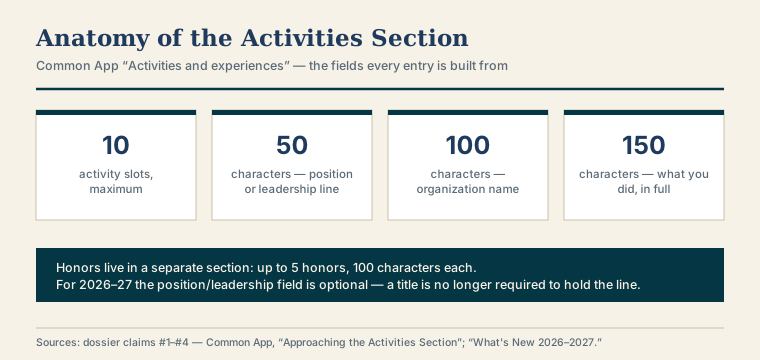
For 2026–27 the Common App calls the section "Activities and experiences." A student may list up to ten activities. Each entry carries a position or leadership description of 50 characters, an organization name of 100 characters, and a description — "activity details, honors won, and accomplishments" — of 150 characters. Honors live in their own section: up to five, at 100 characters each.
One change this cycle: the position field is now optional. A student with no title no longer has to invent one to fill the line. The description carries the weight.
The UC application allows more room — 20 entries across 6 categories, with 350 characters for a main description — and the UC application, field by field maps that format. The writing discipline is identical at either size.
The XYZ Formula
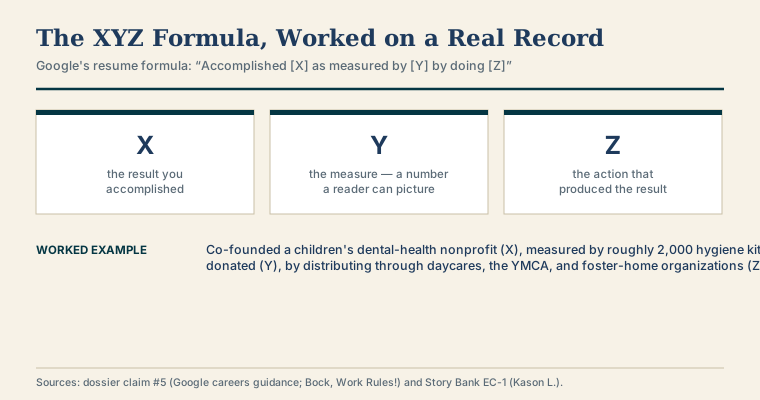
Google's careers guidance gives résumé writers a formula worth stealing whole: "Accomplished [X] as measured by [Y] by doing [Z]." Result first, measured with a number, explained by the action.
Here is the formula at work on a real record. Kason L. co-founded a children's dental-health nonprofit. The membership version of that line writes itself (an illustrative draft, written for this guide): "Co-founder of dental health club. Helped distribute hygiene kits." Meridian's rewrite of the same record, built to the formula:
Co-founded children's dental-health nonprofit; donated ~2,000 hygiene kits through daycares, YMCA, foster-home orgs
That entry runs 115 characters, inside the 150-character field. Its anatomy is the formula's: co-founded the organization (X), measured by roughly 2,000 hygiene kits donated (Y), by distributing through daycares, the YMCA, and foster-home organizations (Z).
Most weak descriptions fail in the same three places — each one a term of the formula gone missing:
- A verb without weight. "Participated in," "helped with," "was a member of" describe attendance. The action term is empty.
- No scale. People, hours, dollars, events, editions, students — a number the reader can picture beats an adjective every time. The measure term is empty.
- No result. What exists now that did not exist before this student showed up? The accomplishment term is empty.
A description carrying an action, a scale, and a result does its job in one reading.
Order Is a Strategy Decision
Students set the sequence of their own list, and the first entries frame everything after them. Three ordering rules cover most files:
- Lead with depth. Four years of one commitment, growing in responsibility, outweighs a sampler of one-semester memberships. On a record like Aahana R.'s, the tutoring entry — roughly 250 hours, a vice presidency, a 500-book drive — is the natural lead: it is the deepest commitment in the file.
- Group what belongs together. Related entries that tell one story (player, then captain, then founder of the off-season program) read as a trajectory. Scattered, they read as hobbies.
- Cut the filler honestly. A club joined in September of senior year rarely adds anything, and it costs the entries around it credibility.
The same discipline governs the essay side of the file; Common App personal statement mistakes covers the five ways students waste the longer form.
Say What the Student Did
The most common framing error describes the organization instead of the student's role in it. "Key Club is a service organization with chapters in many schools" spends the scarcest characters on the application telling the reader something the reader already knows.
Every character belongs to verbs the student owns. Kason L.'s second record makes the point: as Mock Trial treasurer, he raised over $3,000. That number is the entry.
Numbers the Student Already Has
Students insist their activities carry no numbers. Almost always, the numbers exist:
- Time: hours per week, weeks per year, seasons, years in the role
- People: members, students taught, volunteers trained, audience size
- Money: raised, budgeted, earned, saved
- Output: articles published, meals packed, lessons taught, prototypes built, kits delivered
- Change: before and after — team size at joining against team size now, funds last year against funds this year
Where no number exists, a concrete scope word does the work: "every freshman in the program" names a set a reader can count. A number must also be defensible. In the files we review, one implausible figure taxes every believable one around it. The quantification habit also arms the brag sheet — the document a student hands a recommender is built from these same numbers.
The Five-Minute Test
The test takes one question, asked of each description before submitting: could another student at the same school copy this sentence and have it be true of them? If yes, the entry is unfinished. The roughly 2,000 kits, the roughly 250 hours, the second place at NorCal — those belong to one student each. "Passionate member of a dedicated team" could be pasted into any file in the pile.
The Tactical Playbook
- Attach a number or a concrete scope word to every entry.
- Rewrite every description as result, measure, action — in that order.
- Describe the student's verbs; delete the organization's mission statement.
- Count the characters: 150 for the description, 50 for the position, 100 for the organization.
- Fill the position line when the role is real; leave it empty rather than invent a title — the field is optional this cycle.
- Keep awards in the Honors section unless the award is the activity's own outcome.
- Rank by depth; group related entries into visible trajectories.
- Cut senior-year filler; it costs the entries around it credibility.
- Run the five-minute test on every line before submitting.
Start With the List Itself
In our experience, the activities list is the fastest evidence a reader gets — and the page families edit least. Our team starts there: auditing each entry against the record behind it, and rebuilding the descriptions that undersell real work.
If your student's list undersells the record behind it, we invite your family to schedule a free initial diagnostic consultation at meridianprep.com/contact.