Guide
The Common App Personal Statement: 5 Mistakes That Blend In — and What Works Instead
Vanya D. had the two activities every pre-law applicant lists.
Mock trial. Model UN. Respectable, polished, and identical in shape to a thousand other files. Her SAT, a 1080, offered no rescue, so she is applying test-optional, a decision covered in our guide to when to submit or withhold test scores. Her writing would carry weight her numbers usually share.
So her counselor sent her to court.
She began observing live proceedings on a regular basis, eviction court in particular: procedural detail she witnessed herself, of a kind no club simulation reproduces. The personal statement that grew out of those visits had something the activities list could never give it. It had material only she possessed.
That is the whole assignment. The personal statement is where a student supplies primary evidence of how they think — in their own words, at length, on ground they chose. Too many drafts spend it re-describing the file. In our experience, five mistakes account for most of what goes wrong.
The Format, First
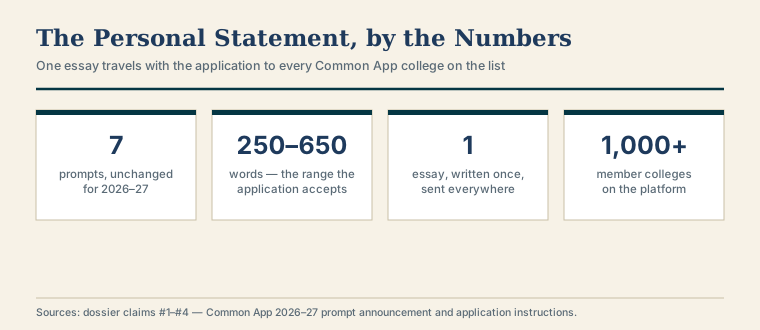
Common App announced on February 27, 2026 that the seven prompts remain unchanged for the 2026–27 cycle: background and identity; a challenge, setback, or failure; a belief questioned; gratitude; a moment of growth; a subject that absorbs the student; and a topic of the student's choice. One essay of 250 to 650 words — the application will not accept a response under 250 — travels with the application to every Common App college on the list, and each college decides whether the essay is required or optional for its applicants. More than 1,000 colleges sit on the platform. For most seniors the essay first comes due with the early rounds: November 1, 2026 is the most common early date, though colleges set their own, and October 15, 2026 and November 15, 2026 both appear. Our desk's working assumption: the essay is read quickly, in a stack, against every version of the same topics that week.
Mistake 1: The Prompt-First Draft
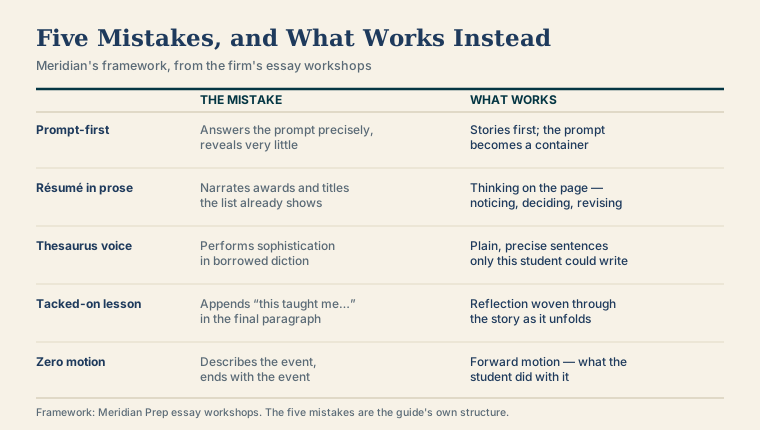
Students agonize over choosing the right prompt, as if prompts were ranked. They are containers. UC says the same about its own questions — all questions are equal — as our guide to the Personal Insight Questions explains. What gets judged is what the student pours into the container.
The prompt choice follows the story: whichever prompt lets the student tell the most specific, most honest story — the topic-of-choice prompt included — is the right container. An essay that answers a prompt precisely and reveals nothing has failed at its only job.
Mistake 2: The Résumé in Prose
The activities list already exists, ten slots, written by the same student. A personal statement that narrates accomplishments — the award, the title, the leadership role — tells the reader nothing new, in a less readable format.
The essay's job is different. It carries thinking: what the student notices, how a setback gets processed, what this person would bring into a classroom discussion. Our companion guide on how to write activity descriptions that quantify impact covers the list's evidence work. The essay covers the mind behind it. If a sentence could move into the activities list without losing anything, the sentence belongs there.
Mistake 3: The Thesaurus Voice
Every year produces drafts where a seventeen-year-old suddenly writes like a legal contract: "utilize" in place of "use," three adjectives where one would do, sentences engineered for impression. Overwritten prose announces itself in the first paragraph, and it raises a suspicion problem — whose voice is this?
Akshay K. arrived with a subtler version of the same problem. His essays — written for the UC questions, where a voice failure costs exactly what it costs here — included a poetry essay written about poetry, its phrasing flagged as AI-sounding. The revision was structural. The poetry essay became verse, followed by a commentary, and the AI-flagged hooks came out. The verse was the risk; the commentary was its anchor.
Two tests catch the problem in any draft. The read-aloud test: anywhere the student's voice runs out of breath or turns into a stranger's, the sentence gets rewritten. The recognition test: a friend who knows the student should be able to hear them in it. What works in its place: plain, precise sentences the student would say aloud.
Mistake 4: The Tacked-On Lesson
The structure is familiar: a long story about an experience, then a final paragraph that begins by announcing the importance of perseverance, empathy, leadership, or hard work. The lessons are interchangeable, which is exactly the problem.
Reflection earns its place woven through the essay — in what the student noticed at the time, in the decision made mid-story, in the detail chosen for inclusion. A lesson that surfaces only in the conclusion reads as an addition, because it is one. When the thinking happens inside the story, the lesson never needs announcing. Our case for why college essays carry this much weight makes the same argument from the reader's side of the desk.
Mistake 5: Zero Motion
The most common version we see is the adversity essay. Something hard happened. The essay describes it thoroughly. Then it ends, with the reader knowing a great deal about the event and very little about the student.
The essay's subject is what the student did with the material. Vanya D.'s plan shows the motion: she went to the courthouse on a regular basis, observed live eviction-court proceedings, and came away with procedural detail she had witnessed herself. Whatever the topic, the revision question is the same — where does the student act in this essay, and where do they only endure? Where the honest answer is "nowhere," that is where the revision starts. Depth signals confidence; breadth signals résumé anxiety.
The Tactical Playbook
- Find the story first; choose the prompt that fits it.
- Draft ugly first; cut second.
- Open inside a specific scene within the first paragraph.
- Check that the student acts somewhere in the essay — decides, builds, attempts, revises.
- Distribute reflection across the essay; delete the summary lesson at the end.
- Move any sentence that belongs in the activities list into the activities list.
- End pointing forward, toward the student the college would be admitting.
- Read the draft aloud; rewrite every sentence that sounds like a stranger.
- Hold the final essay inside 250–650 words; treat 650 as a ceiling.
It Starts With the Material
A student staring at seven prompts and a blank page usually has a material problem wearing a writing problem's clothes. Our team starts there: reviewing what the student has done and witnessed, and finding the story only that student can tell, before a single prompt is chosen.
If that describes your student, we invite your family to schedule a free initial diagnostic consultation at meridianprep.com/contact.