
Guide
Test Scores Are Back on the Table: How to Decide Whether to Submit
Olivia L. had a number she liked. Her diagnostics climbed for months: 1300 on October 1, 2025, then 1350, then 1380, then 1470 on March 8, 2026. Her parents started talking as if she owned the 1470.
She did not.
Her three official SATs told a flatter story: 1310 on December 6, 2025, 1330 on March 9, 2026, and 1280 on March 14, 2026. Her best official score, 1330, trailed her best diagnostic by 140 points. No resolution is recorded yet in her file. A practice score can guide preparation. An official score is the only score a college will ever see.
Optional Means Conditional
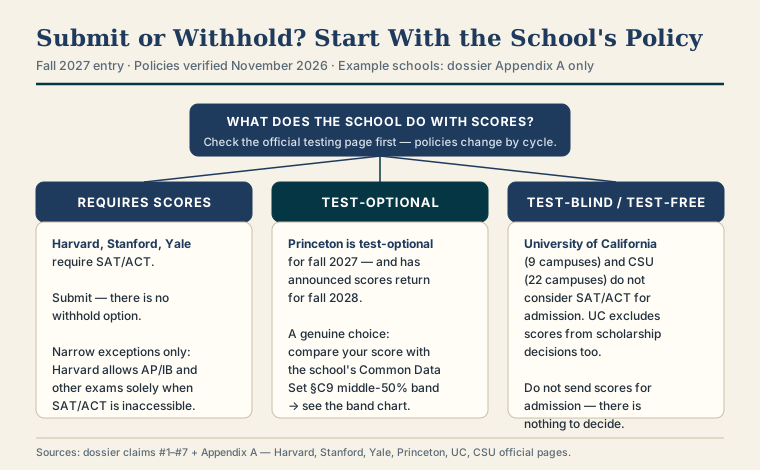
Harvard, Stanford, and Yale require scores for fall 2027. Princeton keeps a genuine choice open for this cycle, and the two large California public systems will not consider SAT or ACT scores in admission at all. Treat every score decision as a local decision: establish the policy, find the enrolled-student band, compare the official score, decide one school at a time.
Step One: Establish What the School Actually Does
Sort every college into its current category, using its own admissions pages. Policies verified November 2026:
- Requires scores. Among the verified examples, Harvard, Stanford, and Yale require the SAT or ACT for fall 2027. Two exceptions stay narrow: Harvard allows AP, IB, GCSE, or national leaving exams only when the SAT or ACT is inaccessible; Dartmouth, also requiring scores, allows alternatives only for students schooled outside the United States.
- Test-optional. The applicant chooses whether to submit; the school reviews the file either way. Among the verified examples, Princeton remains test-optional for fall 2027, states that applicants who withhold scores will not be at a disadvantage, and has announced that scores will be required again for fall 2028.
- Test-blind. Among the verified examples, the University of California, across its nine campuses, does not consider SAT or ACT scores for admission or scholarships for fall 2027. The California State University, across its 22 campuses, does not use SAT or ACT scores for admission; submitted scores may be used for course placement after admission.
- Test-flexible, in a much narrower form. Yale ended this policy for 2026–27 and now requires the SAT or ACT; AP or IB results satisfy a testing requirement only under the exceptions above.
The decision tree below routes by those three live decisions, because the flexible route survives only as the exceptions just named.
Admission and merit-aid policies at the same school can differ, so verify both separately. California families can see how the public systems handle the rest of the file in our field-by-field guide to the UC application and our guide to common mistakes on the CSU application.
UC states no change before the 2026–27 academic year concludes in June 2027, when an Academic Senate review is expected to report; fall 2028 remains undecided.
Step Two: Use the Common Data Set, Section C9
Section C9 of the Common Data Set gives the 25th, 50th, and 75th percentile scores for enrolled first-year students who submitted scores. The middle 50%, between the 25th and 75th percentiles, becomes the working comparison.
Stanford offers the worked example, the one band Meridian verified for this cycle. On its official testing page, Stanford reports a middle 50% of SAT 1520–1570 and ACT 34–36 for its Class of 2029, submitted during its optional era. A 1540 sits inside that band. A 1380 sits well below it. Our guide to what the Common Data Set is and how families should read it covers the full document.
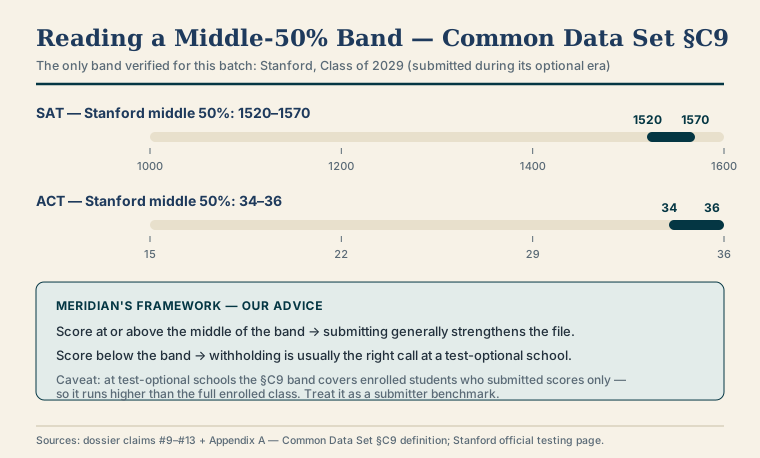
At a test-optional school, Section C9 describes enrolled students who submitted scores. Students who withheld scores are absent from that calculation, so the published band runs higher than a band drawn from the entire enrolled class would. It tells families what submitters looked like.
Meridian's framework for using the band:
- At or above the middle of the band: Meridian generally advises submitting. The score supports the transcript with a second, standardized confirmation.
- Below the band: Meridian generally advises withholding at a test-optional school, provided grades and course rigor carry the case on their own.
- Near the bottom of the band: Context decides. A score strong relative to a student's school and resources may help. A score that repeats what the transcript already establishes adds little.
Princeton's no-disadvantage pledge applies to Princeton alone. Quote a school's promise only for that school.
Step Three: Weigh the Cases, Then Set the Calendar
Vanya D., a senior with pre-law interests in mock trial and Model UN, arrived with an SAT of 1080 and a repaired freshman-year D in algebra. Her counselor set a threshold: unless she could clear 1400, intensive preparation was a poor use of her remaining time. She applied test-optional to a list anchored by George Washington, Fordham, and the UC system, and moved the hours into essays and senior-year grades. Her outcomes are not yet recorded.
Olivia's file points the other way: her officials cluster around 1300 while her diagnostics promise more, so her open question is test-day performance. Ronit K. shows the same split: diagnostics reaching 1500 in August 2026, an official SAT of 1340 on August 22, 2026 — a 160-point gap. His counselor paused prep in September to protect schoolwork, including AP Physics, and set a March restart aimed at 1510 or above; no later official score is recorded yet.
Juniors should settle the testing plan in the spring:
- Take a timed diagnostic of each format, SAT and ACT, and commit preparation to the format that fits. On the redesigned ACT, Science and Writing are optional sections.
- Sit for the first official test early enough to leave a retake window. One date with no slack turns a bad morning into a final result.
- Treat AP scores as a separate, supplementary signal of mastery of college-level coursework. Families often ask whether AP scores really matter; in 2026–27 they rarely satisfy a testing requirement, outside the exceptional cases above.
Admission and scholarship policies can diverge, so pair this decision with our guide to FAFSA and financial aid mistakes that cost families money.
The Tactical Playbook
- [ ] List every target college. Record its fall 2027 category from its own admissions page: required, test-optional, or test-blind.
- [ ] Note any exception that applies, including Harvard's exceptional-case alternatives and Dartmouth's provision for students schooled outside the United States.
- [ ] Pull each college's Common Data Set, Section C9. Record the 25th, 50th, and 75th percentiles for enrolled submitters.
- [ ] Mark each band: at test-optional schools it reflects submitters only.
- [ ] Compare only official scores against the band. Keep diagnostics in a separate column.
- [ ] Apply the framework school by school: submit at or above mid-band, withhold below the band when the transcript carries the case, weigh context near the bottom.
- [ ] Check merit-aid and scholarship testing rules separately from admission rules.
- [ ] Set a first attempt and a retake window. Recheck every policy before submitting.
Start With the List Itself
The submit decision looks abstract until a counselor lays official scores against a specific list, policy by policy and band by band. That comparison is what our team evaluates in an initial meeting.
If your family is weighing a score like Olivia's, or making a threshold call like Vanya's, we invite you to schedule a free initial diagnostic consultation at meridianprep.com/contact. Bring the college list and every official score report. We will work through the decision school by school, with the published numbers on the table.