
Guide
The UC Application, Field by Field: 20 Activity Slots and No Recommendation Letters
Vivaan V. arrived at his August 2026 meeting with a strong headline and a thin file. Class of 2028. Pre-med. A nationally ranked chess player at a public high school in the Inland Empire, with temple volunteering alongside the ranking. Two entries, essentially. His counselor laid that record against the University of California application, with its 20 activity slots, and the empty space did the talking.
The audit did two things. It measured the record: two real entries against 20 slots showed his family how much of a plausible pre-med file existed, and how much was still a plan. And it set the first build item, the clinical ladder, starting with a 100-hour shadowing program that includes operating-room time.
That measurement is the application's real function. The form gives a student unusual room to show breadth, progression, and paid work, then removes nearly every other voice from the file. The student carries the record alone, in tight fields, on one version sent to every campus selected. Strategy follows. Fill categories with evidence. Leave a category empty only by choice.
One Application, Nine Campuses — and No Tailoring
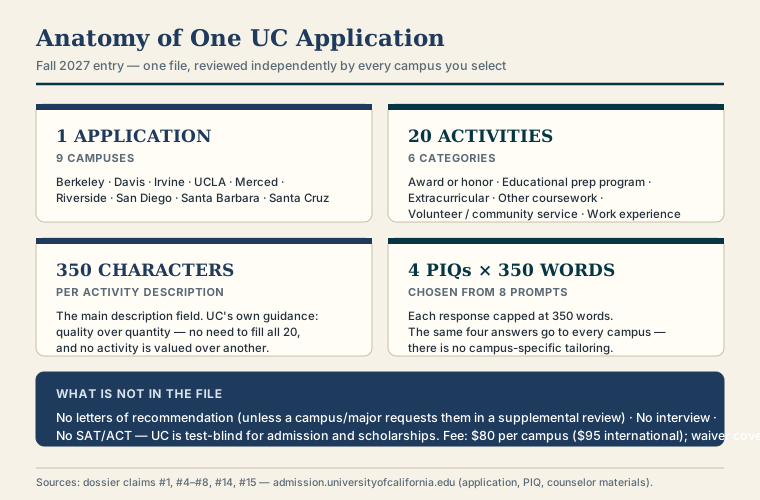
One application serves all nine undergraduate campuses: Berkeley, Davis, Irvine, UCLA, Merced, Riverside, San Diego, Santa Barbara, and Santa Cruz. Every campus selected sees the same activities, grades, and four Personal Insight Question answers. Campuses review independently and weigh that shared file differently.
The fee is $80 per campus, $95 for international applicants. A fee waiver covers up to four campuses for qualified applicants.
The application opened for work on August 1, 2026. The filing period for fall 2027 runs October 1 through November 30, 2026.
UC will not consider SAT or ACT scores for admission or scholarships for fall 2027. Scores have a limited afterlife for placement after submission, a distinction our guide to submitting or withholding test scores walks through in full. Families weighing how a single campus assembles that shared file can see our admissions expert's complete guide to getting into UCLA.
The Activities Section: 20 Slots Across 6 Categories
UC allows up to 20 activities across six categories: Award or honor; Educational preparation program; Extracurricular activity; Other coursework; Volunteer and community service; and Work experience. The main description field allows 350 characters. Some categories add 250-character fields for details such as award eligibility or an organization description.
Quality counts over quantity. An applicant has no need to fill all 20 slots. UC states that it values no activity over another. Meridian's counsel is twelve substantial entries over twenty padded ones: padding spends the drafting time and the characters a real entry needed.
What follows is Meridian strategy, drawn from counseling practice. UC gives no ranking instruction for activities and states no preference among them. Within that boundary, lead with commitments connected to the intended field and to the Personal Insight Questions. Later entries should show progression: the junior varsity season before varsity, the small project before the larger one, the volunteer shift before the coordinator role.
Isaac C. shows how a category audit works. An 11th-grade IB student in the Inland Empire, he arrived at his October 26, 2026 meeting with a varied record never mapped against UC's categories. The mapping surfaced range: he hosts Rubik's Cube competitions that raised about $3,000; he volunteers through cultural programs, food distribution, and English tutoring for children in rural Taiwan; he tutors through Big Brothers Big Sisters and holds Red Cross lifeguard certification.
His counselor singled out one entry many families overlook: his paid work as a swim instructor. Work experience is its own UC category. A paid job described in 350 characters, with hours, learners taught, and responsibility held, fills a part of the form — its own category — that a polished club list leaves blank. The gain is a complete record: evidence spread across the categories a student can honestly fill, rather than depth in two and silence in the rest. Our companion guide to writing activity descriptions that quantify impact covers that discipline: verb first, number attached, outcome stated.
Sort the record by category before polishing any single entry. Gaps become visible at the category level. Polish hides them.
No Recommendation Letters — So the File Has to Speak Alone
Do not submit letters of recommendation for the UC application. UC states that rule plainly. Some campuses or majors may request letters as part of a supplemental application review. That exception belongs to the campus.
UC offers no interview in first-year review, either.
That silence raises the value of two sections families underuse. The Personal Insight Questions provide the student's voice: four answers chosen from eight prompts, each at a maximum of 350 words. Our complete guide to the UC Personal Insight Questions covers choosing stories first and prompts second. The additional comments field provides context in factual, plain language: unusual circumstances or anything unclear in the record — a dip in grades with a real cause, a family responsibility that limited activities, a school with few advanced courses. A separate box in Academic History covers grade and course issues.
Academic History: Self-Reported, and Checked Later
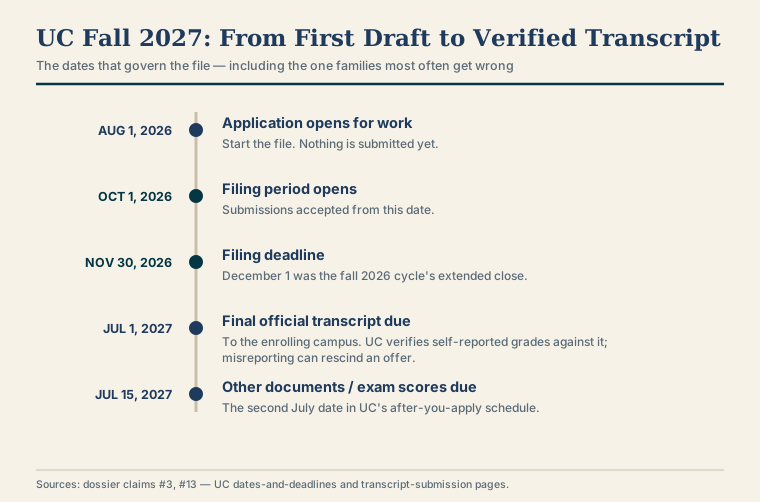
Applicants enter courses and grades themselves, copying titles, grades, and terms exactly as the transcript shows them. Report everything, including a repeated course and a poor summer grade. UC compares the application against the official transcript for admitted students. Final official transcripts are due to the enrolling campus by July 1, 2027, with other documents and exam scores due July 15, 2027. UC verifies the record and can rescind an offer for misreporting.
Families applying to both public systems should keep the forms separate. The CSU application follows different rules, detailed in our guide to common CSU application mistakes.
The Tactical Playbook
- Audit by category first. List every activity under UC's six categories. Mark any empty category; decide whether it reflects the record or an oversight.
- Draft to 350 characters. Write action, scale, and result for each entry. Cut adjectives before cutting numbers.
- Use paid work. Enter jobs and paid instruction under Work experience, with hours per week and weeks per year.
- Sequence with intent. Place central commitments early; arrange later entries to show progression. This is counseling strategy; UC assigns no value ranking among activities.
- Choose PIQ stories before prompts. Select four stories covering ground the activities list cannot, then match them to prompts, at 350 words maximum each.
- Write additional comments as a note. State the circumstance, the dates, and the effect on the record, in factual language.
- Copy the transcript exactly. Enter every course and grade, including repeats and summer grades.
- Calendar the real dates. Work from August 1, 2026. File between October 1 and November 30, 2026. Send the final official transcript by July 1, 2027, and other documents and exam scores by July 15, 2027.
- Budget the fees. Plan on $80 per campus, $95 for international applicants. Check waiver eligibility early; a waiver covers up to four campuses.
Read the File as One Argument
A UC file in good shape reads as one argument: grades that match the transcript, activities sorted across six categories with numbers attached, and four short answers supplying the voice no letter writer will provide. A draft listing everything a student has ever done needs sorting before it needs polishing. In an initial meeting, our team evaluates the category audit, the ordering of the 20 slots, and the four PIQ stories as a single file — the problem this guide describes.
We invite your family to schedule a free initial diagnostic consultation at meridianprep.com/contact.