
Guide
How to Fill Out Your CSU Application Without the Common Mistakes
Jake C. came to his list meeting as a junior, a year before any application opened for him.
A 4.0 unweighted GPA. A 5.0 weighted GPA. An IB diploma in progress, plus dual-enrollment courses already completed at UCLA and UCI. The problem sat in plain sight. Every target was an impacted major at an impacted school. Engineering here. Business there. Each door narrower than the last.
The advice on the table ran against instinct: apply under higher-acceptance majors — human culture, sociology, environmental design and stewardship were the examples — and transfer internally later. His counselor attached the warning at once. That maneuver works better at private institutions than at big publics.
This is a planning-stage lesson in impaction, drawn from a junior's list strategy across systems. Jake had filed nothing, and no CSU outcome hangs on his story. At a CSU, the major decides the pool, and changing it later carries its own contest.
The Easy Application Punishes Casual Work
California families juggle three large applications: the Common App, the UC application, and Cal State Apply. The CSU form has the friendly reputation. For general admission there is no personal essay, no letters of recommendation, no résumé.
Cal State Apply runs on data applicants type themselves, across 22 campuses, and it locks hard after submission. A major selected in haste places a strong student in the most crowded pool available.
Precision is the admission skill here. The transcript does the arguing.
Start With the Profile, and Bring the Transcript
Cal State Apply builds around a shared profile: personal information, residency, academic history. Entered once, it flows to every campus selected.
Residency deserves slow reading. It drives tuition classification and the automatic fee-waiver calculation. It produces a quietly wrong application, charged wrong, that a family repairs campus by campus in the busiest weeks.
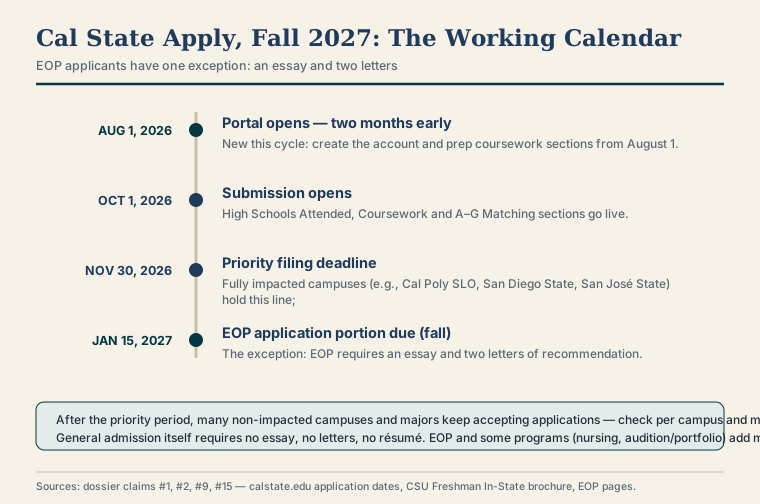
For fall 2027, Cal State Apply opened on August 1, 2026. Submission opened October 1, 2026. The priority filing deadline is November 30, 2026.
Work from paper. Place the transcript beside the keyboard. Every course, every term, every grade. Summer courses. Repeated courses. If it produced a grade, it belongs in the entry.
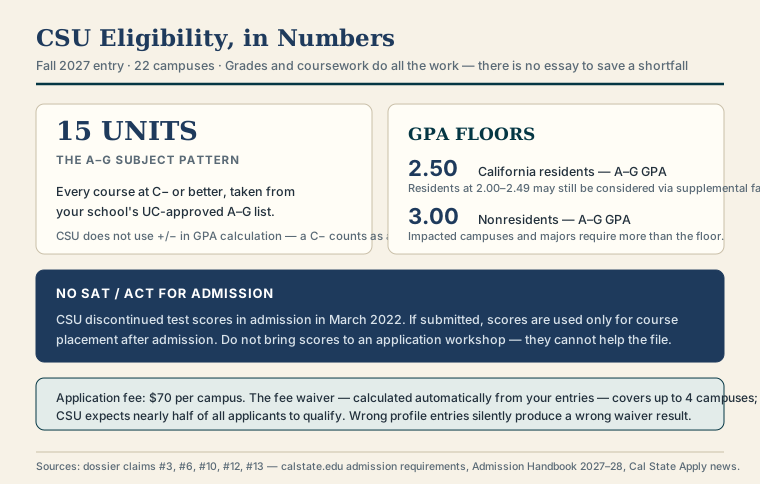
Leave test scores out of the folder. The CSU does not use SAT or ACT scores for admission, a policy discontinued in March 2022. Scores sent after admission may be used for course placement.
Coursework Entry Is Where Applications Go to Die
Applicants enter coursework term by term, and the application matches it against the A–G requirements.
The pattern: a 15-unit A–G pattern, grade C− or better in each course, drawn from the school's UC-approved A–G course list. The CSU does not use plus and minus grades, so a C− counts as a C. California residents need a 2.50 A–G GPA. Students in the 2.00 to 2.49 range may be considered through supplemental factors. Nonresidents need a 3.00. Impacted campuses and majors require more.
Four errors recur:
Course names that drift from the transcript. Enter courses as they appear on the school's approved list. A renamed class can fail A–G matching.
Grades entered from memory. A B that becomes a B+ in recollection. A semester course stretched into a year. Admission is provisional on self-reported data, verified against final official transcripts. Misreporting can lead to a rescinded offer.
Missing terms. Dual-enrollment, summer, and repeated coursework are the easiest entries to forget.
A skipped A–G review. Before submitting, the application shows how the entries map to each subject requirement. Read that screen like an auditor. If a requirement shows incomplete and you know you completed the class, the entry is usually the error.
The neighboring system handles the same self-reported record differently — see our UC application, field by field and whether to submit or withhold test scores.
Campus Sections, Impaction, and the One Real Essay
The CSU varies by campus and by major.
Open every campus and program section. Campuses add their own questions, and impacted programs add criteria. Some programs add materials: nursing applicants and audition or portfolio majors submit program-set supplemental materials. Check each program's list before submitting.
Impaction is published campus by campus and major by major. Fully impacted campuses such as Cal Poly San Luis Obispo, San Diego State, and San José State hold the November 30 priority line. Many other campuses and majors accept applications after the priority period.
That pairing decides whether the alternate-major strategy helps or traps. At CSU, changing into an impacted major after enrollment is competitive, governed by each campus and major's published criteria, and not guaranteed. In some cases it is not possible at all. Choose an alternate major as a degree you would finish. Treat any later transfer as a separate, uncertain application.
Applicants to the Educational Opportunity Program, EOP, do write an essay and submit two letters of recommendation. The EOP portion is due January 15, 2027. A family that repeats "the CSU has no essays" and stops reading will miss the only long-form writing the system asks for.
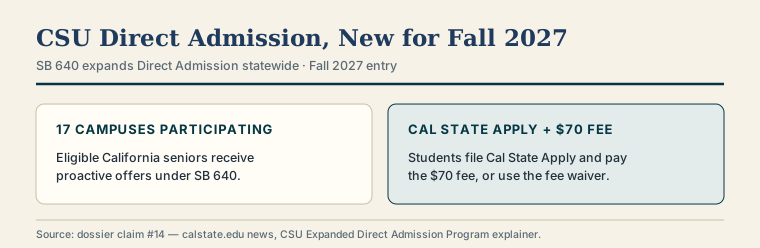
Under SB 640, the CSU has expanded Direct Admission for fall 2027. Eligible California seniors receive proactive admission offers, with 17 campuses participating. An offer does not retire the paperwork: students still file through Cal State Apply and pay the $70 per-campus fee, or use a waiver.
The fee is $70 per campus. A waiver covers up to four campuses for eligible California-resident undergraduates. The CSU expects nearly half of all applicants to qualify. Families working the aid side in parallel should read our guide to FAFSA and financial aid mistakes.
The Pre-Submit Audit
Corrections after submission are handled campus by campus. Submitted coursework does not reopen for tidy editing.
Print or save the complete application. Compare it line by line against the transcript: names, terms, grades. Return to the A–G mapping screen and account for any requirement showing unmet. Confirm each campus and major pairing. Ask plainly: is this the pool the student meant to enter, and would the student finish that degree if a later change stays closed? Verify the account email; decisions travel to that inbox.
Students applying to the UC as well will find a contrast in our guide to the UC Personal Insight Questions, where writing carries the weight data accuracy carries here. Colleges publish their own numbers in our guide to what the Common Data Set is and how families should read it.
The Tactical Playbook
- Build the account now. Cal State Apply opened August 1, 2026; start coursework entry this week.
- File by November 30, 2026 for any impacted campus or major.
- Enter every course exactly as it appears on the transcript and the UC-approved A–G list, term by term, including summer, repeated, and dual-enrollment classes.
- Audit the A–G mapping screen before paying. Resolve every unmet flag; an unmet flag usually points to an entry error.
- Check impaction for each campus-and-major pairing before submitting. At CSU, changing into an impacted major after enrollment is competitive, criteria-bound, and not guaranteed; choose an alternate only if the student would finish that degree.
- Keep test scores out of the admission strategy. The CSU does not use them for admission; placement use comes later.
- Applying through EOP: start the essay and request two recommendations now. The EOP portion is due January 15, 2027.
- Budget $70 per campus. Confirm the automatic waiver, which covers up to four campuses.
- Save a full copy of the submitted application.
Start With the Pre-Submit Audit
If Cal State Apply is on your student's list and the major strategy or coursework entry feels uncertain, we invite you to schedule a free initial diagnostic consultation at meridianprep.com/contact. In that consultation our team evaluates the problems this guide covers — A–G accuracy, impaction exposure by campus and major, and whether an EOP or Direct Admission pathway changes the plan — and maps the next steps.