
Guide
FAFSA Mistakes That Cost Families Eligibility — and the Ones That Cost Them Options
Plenty of families deliver the verdict themselves, at the kitchen table, months before any college sees a form: we earn too much for aid.
Nizmund M. arrived at his initial meeting on October 23, 2026 with that verdict settled: a household above $100,000, earned by his mother alone.
His father died when he was in ninth grade. That fact sat underneath every college conversation the family had.
His counselor declined to deliver a verdict. The meeting ended with homework: Nizmund would confirm the exact household income with his mother, because a rounded memory produces a rounded answer. His counselor would send colleges offering sliding-scale aid, plus a link to Meridian's financial-aid presentation. His list, built around direct-entry BSN programs, would get priced against real aid policies.
No award followed. The work was eligibility-check discipline, applied before assumptions hardened.
Aid Arrives in Layers
Federal aid has one form and calendar. California aid has another deadline. Institutional aid follows each college's rules and priority dates. Merit money adds a fourth layer at many schools, with a FAFSA required on file before release.
Families lose eligibility when they collapse those layers into one yes-or-no judgment. They lose options when they discover a layer after its deadline.
Tuition figures are large and frightening; a household income figure feels like an answer to them. It is an input, one colleges run through formulas families can inspect.
Mistake 1: Assuming You Earn Too Much
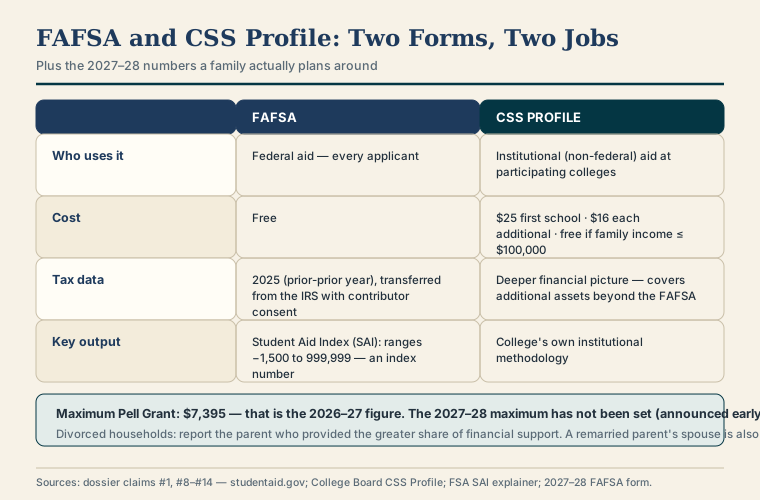
For 2026–27, the maximum Pell Grant is $7,395. The 2027–28 maximum remains unset; Federal Student Aid expects to announce it in early 2027.
Eligibility runs through the Student Aid Index (SAI), which replaced the Expected Family Contribution in 2024–25. It ranges from −1,500 to 999,999; a lower SAI signals greater need. Colleges use the index to calculate eligibility — the figure sits outside any family's payment ledger. For 2027–28, filers see real-time Pell results on submission.
A high SAI closes some doors. Others stay open: Cal Grant follows California's rules, colleges award institutional grants from their own funds, and merit scholarships at many colleges require a completed FAFSA regardless of need.
Colleges publish their aid behavior in the Common Data Set; our guide to what the Common Data Set is and how families should read it shows where. Read each college's numbers before predicting answers.
File the form. Let each layer answer.
Mistake 2: Treating the Deadline as One Date
The 2027–28 FAFSA opened on September 23, 2026 — the earliest launch in the program's history. Any calendar built around October 1 is a cycle stale.
The dates:
- September 23, 2026: the 2027–28 FAFSA opened.
- October 1, 2026: the CSS Profile opened.
- November 1, 2026, and similar early dates: many colleges set aid priority deadlines at their application deadlines. Verify each date on the college's aid page.
- March 2, 2027: Cal Grant deadline — FAFSA or California Dream Act Application plus GPA Verification Form. Community-college applicants get a second date, September 2, 2027.
- June 30, 2028: the federal receipt deadline — latest on the calendar, least useful for planning.
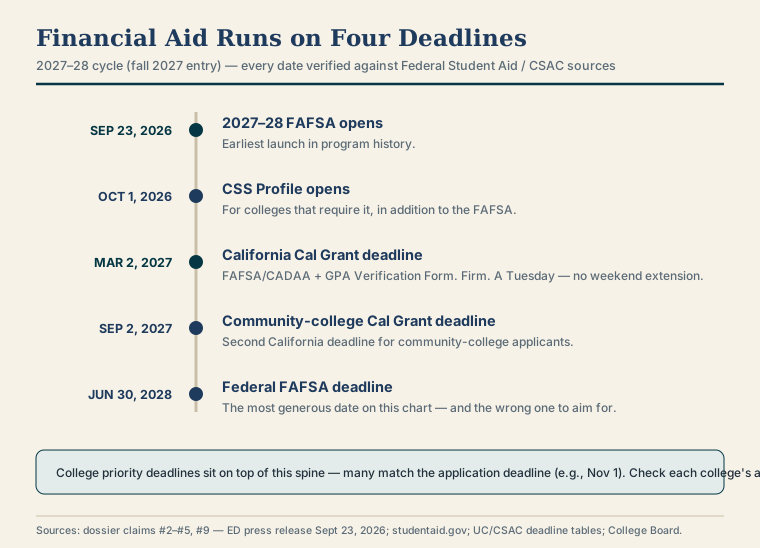
Federal Student Aid puts the stakes in its own terms: state and college deadlines "may be as early as October 1, 2026, or the aid may be awarded on a first-come, first-served basis." Federal Pell Grants and loans follow eligibility rules rather than a queue. File while first-come funds remain open. California applicants juggle application calendars — see our field-by-field guide to the UC application, our guide to common CSU application mistakes, and our guide to the UC Personal Insight Questions.
Mistake 3: Skipping the CSS Profile
Several hundred colleges require the CSS Profile alongside the FAFSA. The College Board describes it as the application colleges use to award non-federal institutional aid, built on a deeper financial picture than the FAFSA collects. Large institutional grants often turn on it.
Fees: $25 for the first school, $16 per additional school, waived for domestic undergraduate families with income up to $100,000.
Seniors whose colleges require it complete it in the fall, on each college's deadline. Check required forms in September; a December discovery of a November 1 deadline leaves explanations instead of aid.
Mistake 4: Filing with the Wrong Contributor
The FAFSA runs on contributors — any person required to provide information on the form. Each needs a separate StudentAid.gov account; new accounts get instant verification, and students can invite contributors by text or email.
Every contributor must consent to direct IRS transfer of federal tax information. Without consent, the student is ineligible for federal aid. A missing consent or signature stalls the file.
For 2027–28, the form uses 2025 tax data, the prior-prior year, IRS-transferred with consent, a design that removes most transcription errors. Remaining errors are human: a name that differs from the Social Security card, a missing contributor, the wrong parent.
Divorced and separated households draw the most confusion, so the rule deserves exact wording. Report the parent who provided the greater portion of the student's financial support; if support was exactly equal, the parent with the greater income and assets. Residence is a separate question. When the reporting parent has remarried, that parent's spouse is also a contributor. Federal Student Aid's "Who's My FAFSA Parent?" wizard settles edge cases.
Mistake 5: Waiting Until Senior Year to Think About Aid
Senior fall is execution season. Families with students in grades 9 through 11 hold a longer lever: time. Three habits use it well.
Asset treatment differs for parent assets and student assets, and shifts by formula. Learn the distinction early, and ordinary savings decisions happen with the rules in view. Keep records exact and findable — tax returns, income figures, account statements. Price the list while it is a draft: read each college's aid behavior, note its required forms, compare likely prices before anyone falls for a campus.
Isaac C., an eleventh-grade IB student, gave his counselor two constraints in October 2026: stay close to home, and keep costs down. Out-of-state colleges earned a place only where strong scholarships or a full ride were realistic. His counselor made list size a financial tool: apply to 25 to 30 schools across reach, target, and safety levels, so aid offers compete. The meeting's example paired UCLA and Cornell — a similar education at a very different price.
Isaac's timing carries the argument: as a junior, he can still rebuild his list as prices come into focus. A senior meets the same list with deadlines on every line.
The Tactical Playbook
- Create StudentAid.gov accounts for the student and every contributor this week.
- Write down exact household income from tax records. Retire the rounded version.
- Build one calendar with one row per college: required form (FAFSA, CSS Profile, or both) and deadline.
- File the 2027–28 FAFSA now; it opened September 23, 2026 and uses 2025 tax data.
- Confirm every contributor has consented to the IRS transfer and signed.
- Divorced or separated: file with the greater-support parent. Include that parent's spouse where applicable.
- File for Cal Grant by March 2, 2027, GPA Verification Form included.
- Budget CSS fees at $25 for the first school and $16 for each additional school, waived up to $100,000 income.
- Build the list for comparison, across more than one price level, so April offers compete.
A Last Word on Assumptions
Nizmund's family wanted a fast answer. Accuracy took one extra conversation, and that trade favors accuracy every time.
If your aid picture rests on an assumption — about income, a deadline, or which parent files — schedule a free initial diagnostic consultation at meridianprep.com/contact. Our team evaluates the exact problem this guide describes: which aid layers your student qualifies for, which forms each college requires, and whether your deadlines leave every layer open. Bring the list.