
Guide
Letters of Recommendation: The Brag Sheet Your Teachers Actually Need
Hazel I.'s file needed witnesses.
Her record was strong and awkward to read: a 4.56 weighted GPA built through an early-college dual-enrollment program, against a 3.76 unweighted GPA that would be weighed at LMU and USC, whose own Common Data Sets rate GPA and rigor "very important." Her record names the counterweight: alongside the transcript strategy, two strong recommendations to lock down — one STEM, one humanities — the other factor those schools rate at the same level.
A letter is the one section of the file the student cannot write. Its raw material is shared: the teacher brings the observation; the student brings the scenes, the specifics, and the story the letter serves. Hazel's recommendations had to be planned like deadlines, with inputs delivered months ahead. The planning instrument has a name: the brag sheet.
The Mechanism
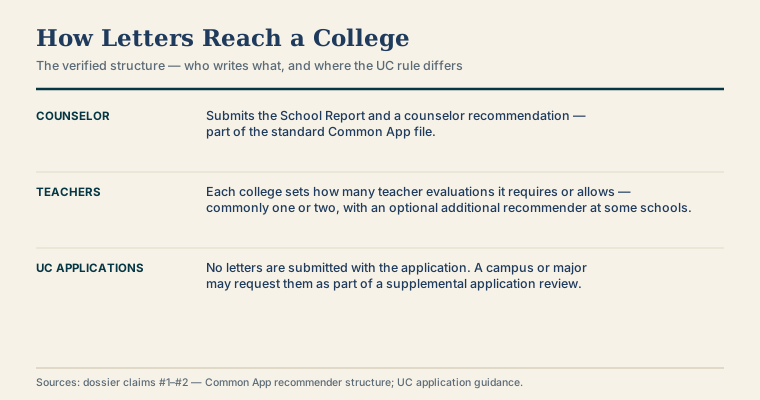
Recommendation requirements are set per college. On the Common App, the counselor submits a School Report and a counselor recommendation; each college then sets how many teacher evaluations it requires or allows — commonly one or two, with an optional additional recommender at some schools. The UC system runs the other way: students should not submit letters for the UC application, though some campuses or majors may request them as part of a supplemental application review.
Which teachers write those evaluations depends on the direction the file argues for — the subject of our guide to choosing a major.
Which Teachers to Ask
The teachers who write the strongest letters share a profile:
- The teacher who saw the student think. A letter that says "she asked the question that changed our class discussion twice this semester" outweighs a glowing letter from a class the student aced without ever being seen.
- Recency carries weight. The junior-year teacher who watched the student grow is a stronger witness than the freshman-year teacher who remembers a quieter, younger version — and colleges that state a preference generally name junior-year or senior-year teachers.
- Core subjects carry weight. Colleges that state a preference generally name teachers of core academic subjects — English, math, science, history, foreign language. A beloved elective teacher can serve as a valuable additional voice where a college allows one.
- Witnesses in other dimensions. The research mentor, or the advisor who watched something get built across two years, can do work no classroom letter can.
Hazel's plan followed the logic: one STEM witness, one humanities witness, each able to testify about a different half of a record that needed both halves believed.
The Ask: Timing Is a Courtesy and a Strategy
Spring of junior year is when strong students ask. This is Meridian's standing counsel, and the reasoning is practical:
- An early ask leaves room. A teacher asked in spring can say yes with a whole summer ahead; a teacher asked in October is fitting the letter around a new school year already at full speed.
- A spring ask buys writing time. The letter can be drafted when thought is possible, ahead of the fall deadlines.
- The ask itself is evidence. Arriving early, in person, with the brag sheet in hand shows the teacher — before a word is written — that this student is organized and serious.
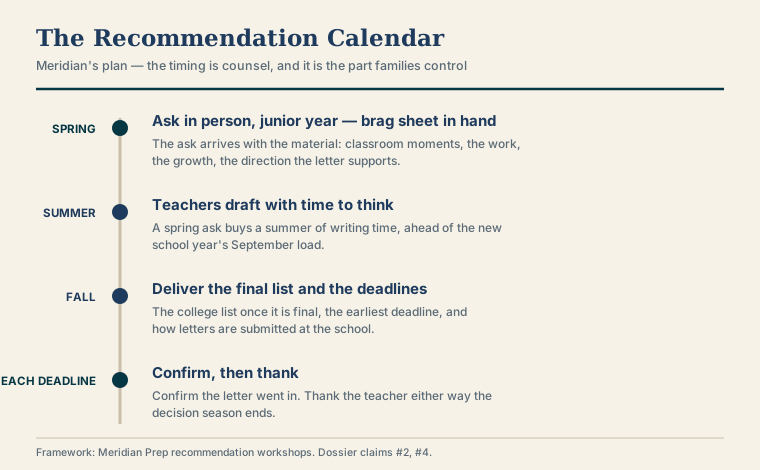
The ask happens in person, and thanks follow regardless of the answer. Hesitation is information. A teacher who suggests that someone else knows the student better has given a useful answer: a reluctant recommender is worse than a different one.
Applicants also state whether they waive their FERPA right to view their letters, and the choice is recorded with the application.
Vanya D.'s file shows the work mid-journey: letters secured from her anatomy and English teachers, paired with the instruction to deepen those relationships through the clubs those teachers advise. The letter improves as the relationship does.
What a Brag Sheet Should Contain
Many schools and teachers run their own brag-sheet forms with their own questions; those get completed fully, in sentences. Whether the form is the school's or the student's own document, the content teachers can use is stable:
- Specific classroom moments. "In October, I stayed after class to argue that the narrator in our novel was lying, and you had me present it the next day." A teacher can open a letter with a scene like that. A teacher cannot invent one.
- Work the student is proud of, with the grade context. The project, paper, or problem set — and what made it hard, alongside the score.
- Growth. Where the student started in that class against where the student finished. Teachers write trajectories gladly when someone hands them one.
- The direction the letter supports. The intended field, the project or passion that defines the student, the circumstances that shaped the record. Teachers should never have to guess what story their letter serves.
- The logistics. Where the student is applying, the earliest deadline, and how letters get submitted at the school — the details that make helping easy, updated in the fall once the list is final.
What stays out: flattery; the full résumé pasted in, a data dump where the teacher needs scenes; and, worst of all, a draft letter written for the teacher to sign. Teachers recognize a scripted letter on sight.
What Readers Are Reading For
A recommendation is the only part of most applications written by someone who watched the student work daily, over months, with no stake in selling the outcome. Our team reads letters as a credibility check and a character witness, and we teach students to supply material for three things:
- Specifics that corroborate the file. Does the teacher's account match the passions and trajectory the student claims? Activity descriptions that quantify impact make the same demand from the student's side of the file.
- Superlatives with evidence. "Among the strongest writers I have taught" means something attached to an example. Alone, it is wallpaper.
- The classroom citizen. Curiosity, generosity to classmates, the response to being wrong — qualities no transcript records.
UC-only applicants submit no letters with the application; a campus or major may still request them in a supplemental review, so the recommenders should be identified either way. At colleges that require or allow letters, they form a real section of the file — and the brag sheet is the student's one lever over that section. Students writing the Common App personal statement in parallel will notice the symmetry: both documents fail the same way, in generalities, and succeed the same way, in scenes.
The Tactical Playbook
- Choose witnesses: teachers who saw the student think, in core subjects, from junior or senior year.
- Build the brag sheet around scenes: a classroom moment, the hard work, the growth.
- State the direction the letter supports and the circumstances behind the record.
- Include the logistics: college list, earliest deadline, submission route. Update them in the fall once the list is final.
- Keep the résumé out of the brag sheet; leave any draft letter unwritten.
- Ask in person, in spring of junior year, with the brag sheet in hand.
- Treat hesitation as information; move to the next teacher gracefully.
- Thank every teacher asked, whatever the answer.
Start in the Spring
The students who receive strong letters asked early, asked the right teachers, and handed over material so specific that writing a strong letter became the path of least resistance.
If your student is approaching recommendation season, we invite your family to schedule a free initial diagnostic consultation at meridianprep.com/contact.