
Guide
How to Choose a Major Without Boxing Yourself In
Aahana R.'s major problem was decided in a classroom she had already left.
By the summer before her senior year, her file was formidable: a 1480 SAT (770 Evidence-Based Reading and Writing, 710 Math), AP scores of 5, 4, 4, and 5, and a deep activity record. The majors under discussion were STEM — biology, biomedical engineering, neuroscience. Her transcript carried the counterargument: a C/B split in accelerated pre-calculus during junior year, and a senior plan built on standard Calculus.
Her counselor named the constraint directly: major selection was the single largest remaining factor in her outcome. In the counselor's judgment, a serious chance at mid- and upper-tier UCs in STEM required AP Calculus or a completed college-level calculus equivalent; without one, competitive STEM at those schools was effectively closed, and biomedical engineering unlikely at any UC. Whether she added the equivalent is a fact her record leaves open. The lesson survives either way: by the time most families argue about the major line on the application, the record has already cast the deciding votes.
Few questions produce more family arguments per minute than "what's your major?" Parents hear a career decision. Students hear a trap. Colleges mean something narrower, and once a family understands what the declared major does inside an admissions office, the decision gets easier.
Myth 1: The Major on the Application Is the Degree
For a large share of students, the declared major is a starting direction. Students change direction constantly once enrolled, after college coursework and exposure to fields that do not exist in high school, and many colleges read the declaration accordingly.
The exception has teeth. Some programs admit by major or by college within the university, and at those schools the declared major is a gate. UC San Diego documents the mechanics publicly. Its selective majors — all Bioengineering majors, Chemical Engineering, Computer Science and Engineering, Electrical and Computer Engineering, Mechanical and Aerospace Engineering, Data Science, and Public Health — are capacity-limited. Applicants are reviewed for their first-choice major, and the university strongly encourages an alternate major on the same application. A student who misses the selective major may be admitted to the alternate, or as Undeclared. Continuing students get one application window a year, after screening courses — each at C− or better, with a 2.0 UC GPA minimum — with selection competitive and not guaranteed.
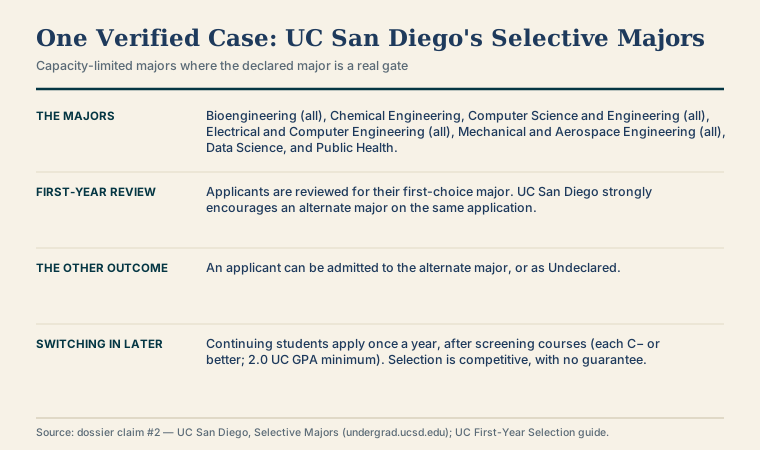
The first strategic question is whether, at a given college, the major choice changes the admissions odds or the ability to switch later. That answer varies by school, which is why list-building and major-choosing are the same conversation.
Myth 2: Undeclared Is the Safe Play
Undeclared feels safe because it feels honest. Sometimes it is — some colleges admit to a general college and expect exploration. As a default strategy it has two problems.
First, it forfeits the story. Readers build a picture from activities, essays, and intended direction. A student whose file shows three years of robotics, a research project, and a declared interest in engineering presents a coherent argument. The same file marked "undeclared" asks the reader to do the connecting work.
Second, at schools that admit by program, "undeclared" can mean the general pool plus a hard road into the popular major later — the UC San Diego mechanics above, read from the other side.
The middle ground is a declaration the record supports. An application should argue a thesis — here is what the student has explored, here is where it points — and the major line is where that thesis gets stated.
Myth 3: Pick the Quiet Major and Sneak In
Every year, families propose the classics: an application as a classics major, a switch to business later. Colleges have seen this film. Readers evaluate whether the record supports the declared interest, and a file full of finance internships declaring ancient Greek reads as maneuvering. Worse, at schools that restrict switching, as UC San Diego does for its selective majors, the maneuver strands the student outside the wanted program — admitted and enrolled, with one competitive application window a year and no guarantee.
A legitimate version of the thinking exists: where a student's interests honestly span two fields, choosing the one with the clearer pathway is sound strategy. Isaac C.'s file shows the honest form. His counselor's plan declared a different major at every school, each one supported by his record — his tutoring work and paid swim instruction backed an education-facing major. The test is whether the interest is real and documented, and whether the activities can defend the declared major out loud.
The Three-Check Method
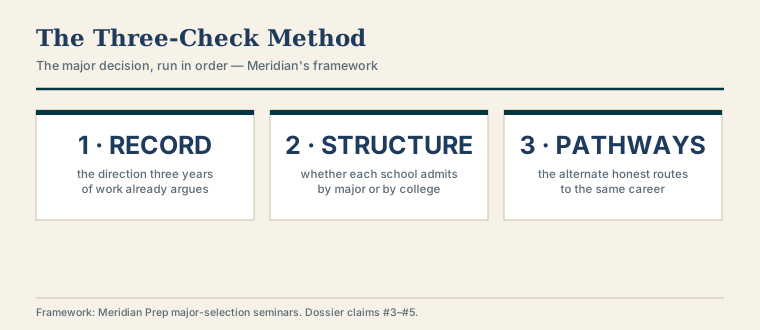
Check one: the record. List the courses, grades, activities, and projects. Which direction do they already argue for? Aahana R.'s record argued for depth in service and research — tutoring, a climate team, a neuroscience cohort — and against an engineering run attempted without AP Calculus or a college-level equivalent. The best major choice is usually the one the last three years have been quietly making.
Check two: the school's structure. For each college, learn whether it admits by major or by college, whether the target program is capacity-limited, and how internal transfers work. The Common Data Set publishes the relative importance of the factors each school weighs — what the Common Data Set is and how families should read it walks through that document — and each school's own admissions pages carry the major mechanics, as UC San Diego's do. The UC application, field by field treats the impacted-major mechanics of the UC form itself.
Check three: the alternate pathways. Many sought-after careers have more than one door. Pre-med is a set of courses medical schools require, and any major can carry them. Law schools admit students from every major; the ABA prescribes no undergraduate path. When a student maps two or three honest routes to the same career, the declared-major decision becomes a well-chosen starting line.
The Question Underneath the Question
When a student cannot pick a major, the cause is usually upstream. Activities chosen to look good generate no signal about what the student likes, so nothing exists to decide from. The cure is a year of doing things specific enough to produce a preference: a real project, a real course, a summer spent producing something, work in the community. That evidence is also the file's raw material, and how to write activity descriptions that quantify impact shows how it reads on the page.
The Tactical Playbook
- Audit the record first: list courses, grades, activities, and projects, then name the direction they argue.
- Flag any course the target major expects that the transcript lacks; add it while the schedule allows, or change the target.
- Check every school on the list: admission by major or by college, capacity limits, internal-transfer rules.
- Read the selective-major mechanics before declaring into a gated program, and name an alternate the record supports.
- Map two or three honest routes to the target career.
- Declare the direction the record supports; reserve undeclared for schools built for exploration.
- Refuse any declaration the activities cannot defend out loud.
- Recheck the plan after junior-year grades land.
Start With the Record
Major strategy is list strategy, and both begin with the same audit: what the record already argues, school by school. The audit is cheapest while a missing course can still be added and a declaration can still be earned.
If the major argument is live in your house, we invite your family to schedule a free initial diagnostic consultation at meridianprep.com/contact.