Guide
Competitive Summer Programs: Worth It? A Vetting Framework
Neil G.'s summer planning started in September of his junior year, inside a meeting about his capstone. His record was already the spine of his file: a migraine study underway with a professor mentor and a publication track, shadowing in a VA hospital emergency department and an ICU, two weeks shadowing a neurologist, a cardiologist shadowing rotation, a Kaiser shadowing program completed. His counselor's direction was to convert that shadowing into a capstone — and, in the same plan, to calendar the summer: work on applications to COSMOS and RSI would start in October, ahead of deadlines in December and January.
That is the right order of operations. The summer after junior year is the last open block before applications, and a family that begins in March has already chosen from whatever remains.
Every family in that planning season also meets the other kind of summer: the brochure. A storied university's name in large type, teenagers laughing on a historic quad, and a quiet implication, never quite stated, that this is how students get in. Telling a selective program from an expensive one wearing a famous name is a learnable judgment. It starts on the reader's side of the desk.
What Readers See
Our firm's working view: readers at competitive colleges know which programs run real admissions standards and which run revenue operations under a famous name; a university's own pre-college arm is often a business unit, and its certificate carries the weight of the standard behind it. A certificate of completion is a receipt. What earns a reader's attention is selectivity that can be described, teaching by people who do the work, and output that survives the summer — with the evidence drawn, wherever possible, from the operators' own published terms.
Three Programs, Three Kinds of Selective
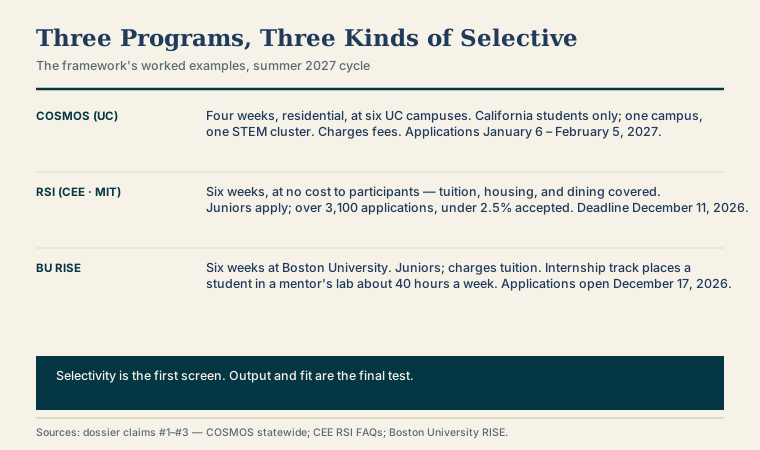
COSMOS — the California State Summer School for Mathematics and Science — runs four weeks, residential, at six UC campuses, for students attending California high schools. Each student applies to one campus and studies in one subject cluster, and each campus takes roughly 150 to 250 participants. Applications open January 6, 2027, with all materials due February 5, 2027, for a session running July 5 to 31, 2027. COSMOS answers the selectivity question with a capped cohort, and it carries a second lesson. Jake C., a junior whose counselor was working his list the same fall, received it: his counselor advised applying to less-obvious COSMOS tracks — aquaponics was the example on the table — on the reasoning that selectivity is read at the cluster level. COSMOS publishes no cluster-level acceptance rates, so the advice stands as a counselor's reasoning, and it holds only among clusters that fit the student's own line.
RSI — the Research Science Institute, run by the Center for Excellence in Education with MIT — is the extreme case: the only program on this page with an operator-published acceptance rate charges its participants nothing — tuition, housing, and dining covered. Six weeks: one of intensive classes, then five of mentored research ending in a paper and a symposium presentation. Students apply during junior year and must be 16 by July 1, 2027. The Center reports over 2,500 U.S. applications and 600 international ones, with under 2.5% accepted — and the deadline is December 11, 2026, which is why the planning starts in the fall. RSI answers the selectivity question outright, with a published rate.
BU RISE, at Boston University, runs six weeks for students in junior year, in two tracks: Internship, an individual research project in a BU lab at roughly 40 hours a week under a mentor, and Practicum, group computational research. Applications open December 17, 2026, for a session running June 27 to August 6, 2027. RISE charges tuition, and this guide prints no figure for it, because price and selectivity are separate variables, easily confused. RISE answers the selectivity question with gates: juniors only, an application, mentor-supervised tracks.
The Five Vetting Questions
Selectivity is the first screen. Output and fit are the final test. Five questions, in order:
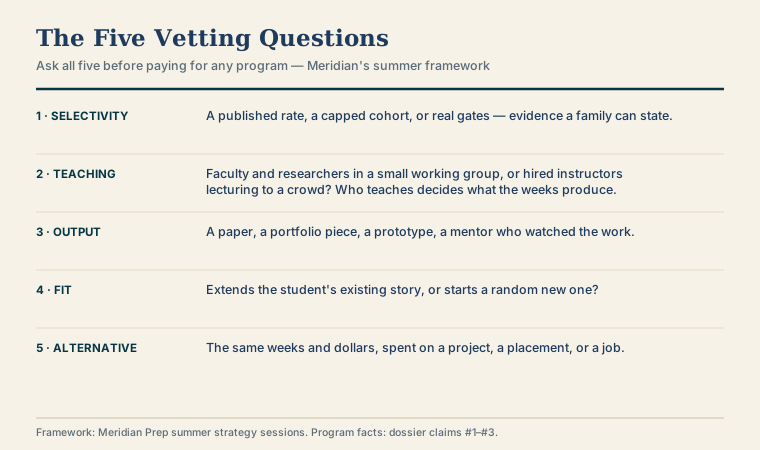
1. How selective is it, actually? Look for evidence in any of three forms: a published acceptance rate, as RSI prints; a capped cohort, as COSMOS runs; or real gates — eligibility limits and a genuine application with essays and recommendations, as RISE requires. A program whose only gate is a registration form and a credit-card field has told a family its standard.
2. Who teaches? Faculty and researchers working with a small group produce a different summer from hired instructors lecturing to a crowd. The mentor matters doubly: the person who teaches is the person who can later write about the work.
3. What does the student produce? A research paper, a portfolio piece, a prototype, a presentation. Artifacts and witnesses. Something to point to, and adults who watched it happen and can say so.
4. Does it extend the student's story? The right program continues a line already visible in the record — the way Neil's summer had to extend a clinical line that was already his file's spine. A prestigious detour is a paragraph from a different application.
5. What is the alternative use of the same weeks? A self-directed project, a placement, a job. In our reading, real work, with supervisors and stakes, produces the same three things the questions hunt for. The expensive program is one route among several, and it earns its place only when it produces more of those three things than the alternatives would. The same output standard governs internships in high school, where the tests apply to placements.
The Two Traps
The first trap is the invitation letter. "Selected," "nominated," and "invited to apply" mailers travel to mailing lists. A program that found a student through a list has disclosed its admissions model. The mailer is marketing, and the five questions apply to whatever it advertises.
The second trap is subtler: assuming a selective program is automatically the right one. A genuinely competitive research program in a field the student does not care about produces six weeks of adequate work and nothing to write about. Fit beats prestige — in summers as in college lists, a point our guide to choosing a major makes from the other direction. The student's own line decides which selective programs are worth winning.
The Tactical Playbook
- Start in the fall of junior year and calendar the dated windows: RSI's deadline is December 11, 2026; RISE applications open December 17, 2026; COSMOS applications run January 6 to February 5, 2027.
- Treat every invitation mailer as marketing until the questions say otherwise.
- Run all five questions before paying for anything, and write the answers down.
- Read selectivity at the level the program selects — the cluster, the track, the cohort — and only among options that fit the student's line.
- Demand an output: a paper, a portfolio piece, a mentor who can write.
- Check fit against the record the student already has; a detour costs a summer.
- Price the no-cost alternative: a project, a placement, or a job producing the same output.
Planning Starts in the Fall
Summer planning belongs in the fall or winter before, while deadlines still allow real choices. It starts from the student's record: the lines already running, the outputs already planned, the summers that would extend them. Families weighing a program against a project can pressure-test both against passion projects that get finished and activity descriptions that quantify impact, which set the output standard any summer has to meet.
If a summer decision is on your family's table, we invite your family to schedule a free initial diagnostic consultation at meridianprep.com/contact.