Guide
Passion Projects: How to Scope One That Actually Gets Finished
Anish P.'s Scout record looked like thousands of other Scout records.
Same troop, same campouts, same advancement ladder — on paper, indistinguishable from every other Scout file a reader would see that week. His ambition ran at computer science. Nothing in the service record argued for it.
The project his plan turned on was scoped in one meeting, on July 29, 2026, and it was small enough to describe in a single sentence: build a more efficient event sign-up system for his own troop. PostgreSQL on the back end, a Retool front end, designed for real users from the first week — the troop itself, signing up for real events. The build is not recorded as complete. What the scoping already produced is a deliverable with a definition, a user with a name, and a size a student can carry.
Every counselor knows the archaeology of the other kind. A layer from sophomore year: the nonprofit idea, announced to the family group chat, with a logo. A layer from junior fall: the app, the podcast, the platform — three of them, overlapping. By application season, a student is writing about one of these projects in the present tense, hoping nobody asks what it produced.
This guide takes the scoping method as its subject — shown at the moment of decision, with no finished case claimed. An unfinished project, honestly framed, is weaker than a modest project that finished. Ambition is cheap at sixteen. Follow-through is the rare commodity, and follow-through is what a passion project exists to prove.
Start Smaller Than Instinct Suggests
Students scope projects like movie pitches: the biggest version, aimed at the biggest audience. An app for every student with anxiety. A nonprofit for every underserved school in the county.
Engineers scope differently. The working question: what is the smallest version of this that is real?
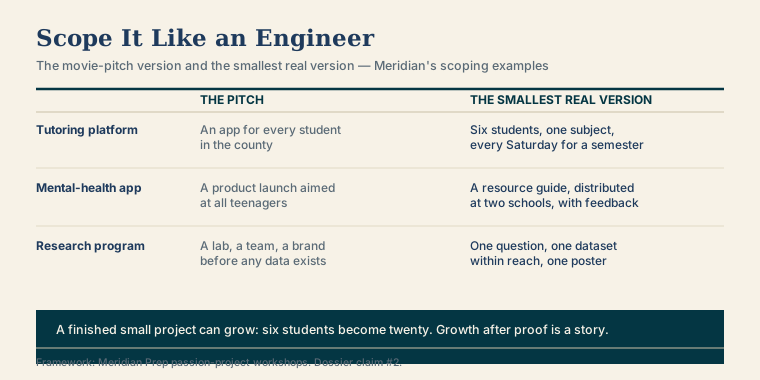
Anish P.'s scope passes the test the platform ideas fail. One troop. One workflow. Users who will complain when it breaks. A small real thing produces evidence: participants, sessions held, materials created, outcomes a reader can count. A huge imagined thing produces adjectives. Our counselors can tell which one they are looking at within a paragraph, because one can answer follow-up questions and the other cannot.
A finished small project can also grow: six tutees become twenty, the guide becomes a workshop. Growth that follows proof reads as a story; scale claimed ahead of proof reads as a pitch.
Work Backwards From a Deliverable
"I want to do a project about ocean plastics" names a topic. A project ends with a thing that exists:
- A guide, dataset, exhibit, performance, or product in the world
- A measurable outcome — people reached, money raised, sessions run, results published
- A public artifact someone else can inspect: a site, a paper, a presentation, a partner organization able to confirm the work happened there
The deliverable comes first; the smallest honest path to it comes second. This is also how a student knows when the project is done — a question vaporware can never answer.
Neil G.'s capstone plan shows the deliverable discipline inside a research context. Neil is a junior whose clinical record most students would coast on — a migraine study with a professor mentor, shadowing in a VA hospital emergency department and ICU, two weeks shadowing a neurologist, a cardiologist shadowing rotation. His counselor set the next step as production: brainstorm 10 to 20 capstone ideas framed as hypothesis and null-hypothesis pairs, choose the most distinctive, and build it to measure community impact with numerical data. The plan was set in September 2026, with no outcome recorded. Observation becomes a deliverable the day someone defines what the project will produce and how its effect will be counted — the same line our internships guide draws between watching work and doing it.
Meridian builds student stories around community-centered projects — work aimed at a real need in the student's own community, with people able to vouch for it. That structure is stronger for a plain reason: a project plugged into a community arrives with witnesses, milestones, and an answer to the reader's hardest question — did this happen, and did it matter to anyone besides the applicant?
Structure Catches the Project
Projects die when school gets busy and nothing holds the slot. The fix is boring and total, and it has three parts.
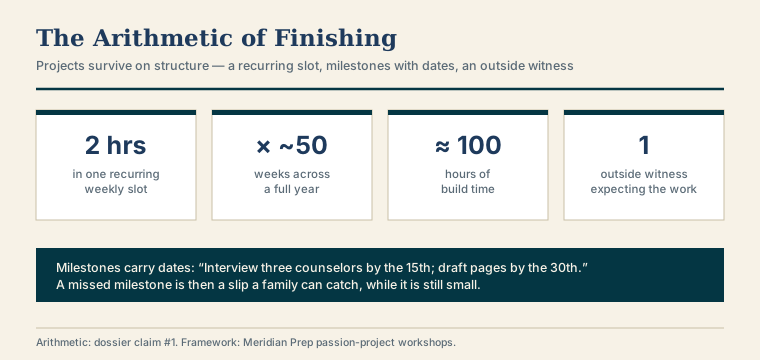
The first is a recurring slot: the same time every week, on the calendar, treated like a class. Two focused hours weekly across a year add up to roughly a hundred hours — arithmetic, and a serious block of build time. The second is milestones with dates. "Interview three counselors by the 15th; draft pages by the 30th" catches a slip while a slip is still small. "Work on the guide" catches nothing. The third is an outside witness — a mentor, a partner teacher, a community organization expecting the deliverable. Accountability to a real person carries the weeks when motivation does not show up.
Parents help most by protecting the slot and noticing when milestones quietly stop happening — structure is the part of the system a family can supply.
Document Like It Will Need Proving
The application offers no "trust me" box. Documentation turns a project from a claim into evidence:
- The artifacts. Drafts, photos, sign-in sheets, partner emails, before-and-after versions — in a folder, updated as the work happens.
- A weekly log of numbers. Sessions held, participants, hours, outputs. Each entry takes minutes. At application time, the log becomes the activities description, written the way our activity descriptions guide teaches. The Common App gives that description 150 characters, which is why the counts matter. The same log supplies detail for the essay.
- Third-party proof. A thank-you letter, a partner's line of confirmation, a local mention, results data. One sentence from a real organization outweighs a paragraph of self-description.
What Readers Are Testing
At Meridian, we read every passion project against four questions — the summary our counselors use: Is it real? Is it the student's own? Did it last? Did it touch anyone beyond the student?
Scale appears nowhere on the list. A two-year project serving thirty real people, with a logbook and a letter from the site director, would pass every test on it. A nonprofit with a website and no activity fails all four. Starting a club vs. joining one applies the same tests to organizations. The Congressional Award guide shows a national structure that exists to certify this kind of sustained work.
The Tactical Playbook
- State the deliverable in one sentence before any other planning.
- Shrink the audience until the project is real: one troop, six students, two schools.
- Block a recurring weekly slot on the calendar and treat it as a class.
- Date every milestone, and size each one so a miss is a slip.
- Recruit an outside witness who expects the deliverable.
- Open a documentation folder on day one; log the numbers weekly.
- Collect third-party proof as the work happens.
- Finish the small version before expanding it.
- Write the application description from the log, with counts attached.
Start With the Scope
A project idea that arrives too large, too vague, or already stalled is a scoping problem, and scoping problems are cheapest in the fall of the year before they matter. Our team would rather help a student right-size a project early than help explain it the following application season.
If a passion project sits on your student's plan, we invite your family to schedule a free initial diagnostic consultation at meridianprep.com/contact.