
Guide
Starting a Club vs. Joining One: The Tells Counselors and Readers Look For
Kason L.'s file, reviewed at his intake the summer before his junior year, looked scattered on paper — science, service, and performance, with no visible spine. The audit underneath it told a different story. By that summer he had already co-founded a children's dental-health nonprofit. The organization has donated roughly 2,000 hygiene kits, distributed through daycares, the YMCA, and foster-home organizations. His Science Olympiad team had placed eighth at the California state tournament. As Mock Trial treasurer, he had raised over $3,000.
Beside that record sits the standard senior-year founding: a name, a constitution copied from the internet, an account on a social platform, two meetings, and a line on the activities list reading "Founder & President." Both students reach for the same word — founder. Only one of them holds an organization.
"Founder" has become the most counterfeited title in high school. Students absorbed the message that founding beats joining, so founding got industrialized. The difference between the two files shows on the page, in structural tells, and knowing them separates a founding that strengthens an application from one that taxes it.
The Tells Counselors and Readers Look For
The tells are structural, and every one of them sits inside the student's control. What follows is Meridian's framework, assembled from the firm's club-founding counsel:
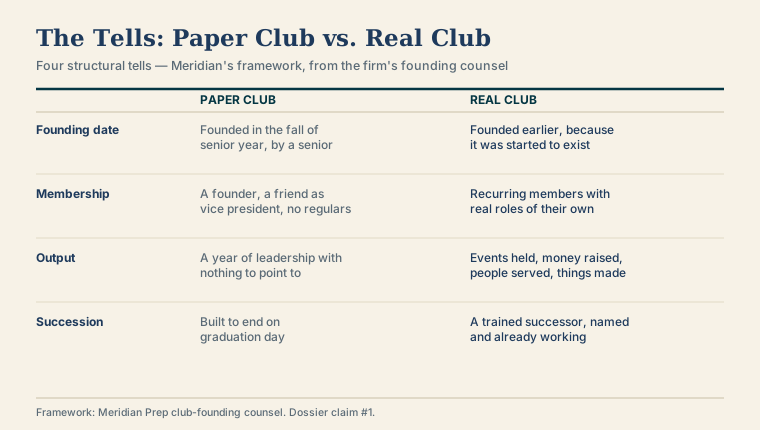
- The founding date problem. An organization founded in the fall of senior year, by a senior, announces its own motivation. Real organizations usually start earlier, because they were started to exist.
- No membership reality. Who comes? How many, how often, for how long? A founder, a vice president drawn from the founder's friends, and no recurring members describe a letterhead.
- No output. Real organizations do things that leave evidence: events held, money raised, people served, competitions entered, things made. A year of leadership that produced nothing pointable was nominal leadership.
- The succession void. What happens when the founder graduates? Real founders recruit younger members, train a successor, hand something over. Paper clubs are built to end on graduation day.
The evidence sits on the page — in the activity description's numbers or their absence. The Common App gives that description 150 characters, the UC application 350 for a main description, and our activity descriptions guide shows how much proof either space can hold when a student writes it properly. Kason L.'s record gives that space counts and distribution partners to work with. The paper club fills it with the title, twice.
What Founding Something Real Looks Like
Meridian's founding counsel starts with a genuine gap.
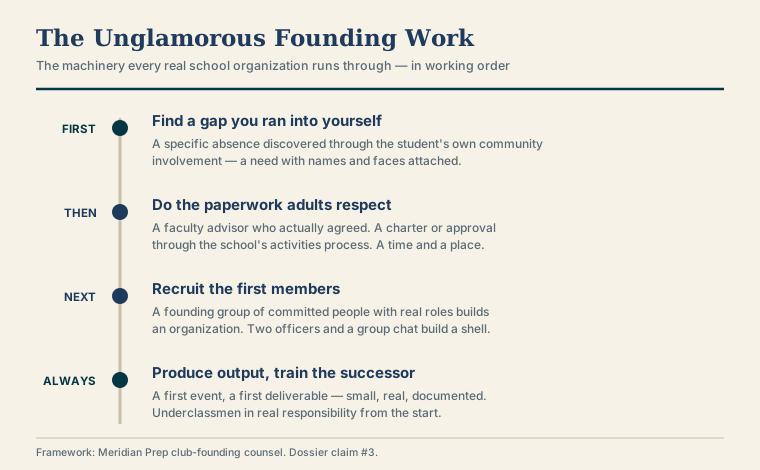
Find a need with names attached. The strongest foundings begin with a specific absence the student personally ran into: the middle schoolers in the neighborhood with no math help, the new families at school working through unfamiliar forms alone, the local creek nobody monitors. A gap discovered through the student's own community involvement beats a category selected from a list of clubs colleges supposedly like. The nonprofit Kason L. co-founded works in children's dental health — a need with beneficiaries a reader can picture and partners a reader can name.
Do the unglamorous founding work. Every real school organization runs through the same machinery: a faculty advisor who actually agreed, a charter or approval through the school's activities process, a meeting time and place, a way to recruit. Students who have done this work can describe it in detail. Students who skipped it go thin under the first follow-up question.
Recruit like it matters. First members are the organization. A founder who pulls together a founding group of committed people and gives them real roles has built something. A founder with two officers and a group chat has built the shell of an organization.
Produce visible impact early. A first event, a first service day, a first deliverable — small, real, documented. Impact compounds: the second semester can be bigger because the first one happened. Our guide to passion projects that get finished teaches the same scoping discipline for work that lives off campus.
Plan the succession from the start. Recruit underclassmen into real responsibility early enough that the handover is a fact. "The club continues under a junior I trained" ranks among the most credible sentences in an activities list, because paper clubs can never write it.
When Joining Is the Better Move
Founding is one route to evidenced leadership. Frequently, joining is the stronger one:
- When a strong organization already exists, rising inside it — member to organizer to officer across two or three years — demonstrates sustained commitment and leadership granted by other people. Granted leadership carries a credibility self-declared titles cannot borrow. Aahana R.'s record runs on this track: ecology club event director for two years, incoming president; vice president of a tutoring organization. Each of those titles was earned inside a structure that predates her.
- When the honest interest is the activity itself. A student who loves debate should debate at the highest level available. Founding a duplicate debate club to hold a title wastes the years.
- When time is the real constraint. A genuine founding is a serious build. For a student already carrying a deep commitment — a job, a family responsibility, a serious pursuit — depth in one existing thing beats a thin founding layered on top. The alternatives deserve a look on their own terms: the placements in our internships guide carry the same evidence standard.
Membership numbers, outputs, years, and successors carry a weight that titles alone cannot.
The Question to Ask Before Founding Anything
The question removes the application from the reasoning: would this student build this organization if no admissions officer would ever learn of it? A genuine yes deserves a real build, started early. Any other answer tends to show in the file anyway, attached to the whole application.
The Tactical Playbook
- Ask the question first: would the student build this if no admissions officer ever learned of it?
- Join when a strong organization already exists, and rise there toward leadership other people grant.
- Start from a gap the student personally ran into, with names and faces attached.
- Secure the advisor, the charter, and the meeting time before anything else.
- Recruit committed members and give them real roles.
- Ship a first visible output inside the first semester.
- Document counts from the first meeting: attendance, events, people served.
- Recruit underclassmen into real responsibility from the start, and train a successor.
- Write the activity description from the evidence: numbers, outputs, successors.
The Audit Before the Decision
"Should my student found something, or go deeper in what already exists?" is one of the best conversations a family can have in ninth or tenth grade, while both options remain real. Our team works through that comparison with families against the student's actual record — the commitments, the gaps, the hours available.
If that question is live in your house, we invite your family to schedule a free initial diagnostic consultation at meridianprep.com/contact.