Guide
Internships in High School: What Counts, What Doesn't, and How to Get One
Isaac C.'s most credible work experience was already on his record, filed under a plain name: a paid job teaching swimming.
The job had an employer, students in the water, wages, a supervisor who could describe exactly what he did, and responsibility that grew across seasons. On the UC application, paid work is its own activity category. His Rubik's Cube competitions, which raised about $3,000, carried the same quality: stakes, outcomes, a countable result.
"Internship" might be the hardest-working word on the modern application. It covers the student who ran real analyses in a university lab for eight weeks, and it covers the student who twice carried coffee into a family friend's office and updated a spreadsheet once. Readers are aware of both definitions. Only one of them helps.
What Counts: The Three Tests
An internship that moves a reader passes three tests. The tests are Meridian's, drawn from our internships workshop:
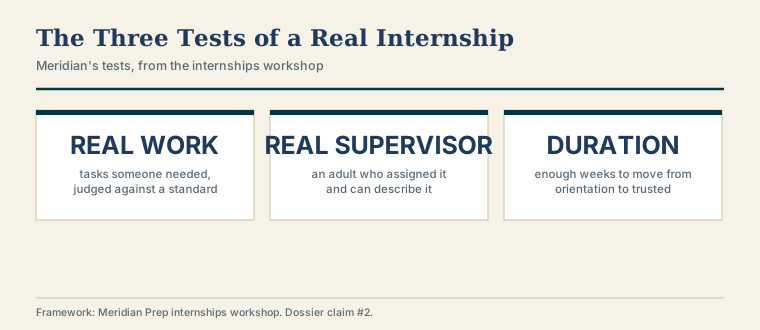
- Real work. Tasks someone actually needed done, with a standard for whether they were done well: data cleaned, samples prepared, clients served, code shipped, events run. Work nobody would miss is not work yet.
- A real supervisor. An adult outside the family who assigned the work, can judge it, and could describe it to a stranger. That person is also a future reference, which is part of the placement's value.
- Duration and stakes. Enough weeks and hours to progress from orientation, to competence, to being trusted with something. A two-week shadowing experience can be educational; the honest label for it is shadowing. Readers respect the honest label more than the inflated one.
Isaac's swim job passes all three with the word "intern" nowhere near it: students in the water, a supervisor, wages, and responsibility that grew across seasons. Readers weigh the work, whatever name it carries.
Vivaan V.'s clinical record shows the honest labelling from inside a pre-med file. His ladder begins with a 100-hour shadowing program that includes operating-room time — observation, named as observation — while the long game targets 2,000 to 3,000 hours of direct patient care in medical assistant, CNA, or EMT roles across the years before medical school. The shadowing teaches; the patient-care hours are the work the ladder is building toward. A file that keeps the two categories straight reads as credible everywhere else, too.
Research placements count fully under these tests. So does the ordinary paid job, as Isaac's swim instruction shows. So does skilled work inside a small local business: the bookkeeping, marketing, or operations of a working company can run richer than a famous-name placement where high school students are kept in a separate, harmless track. What fails the tests: purchased "internship experiences," titles arranged through family connections with no duties attached, and anything the student could not describe in concrete verbs, task by task.
How Students Get Them: The Outreach Method
High school internships are created, one conversation at a time, in a market where postings aimed at high school students are rare. In our workshop, students leave with a draft cold email and a short list of specific places to contact. The method:
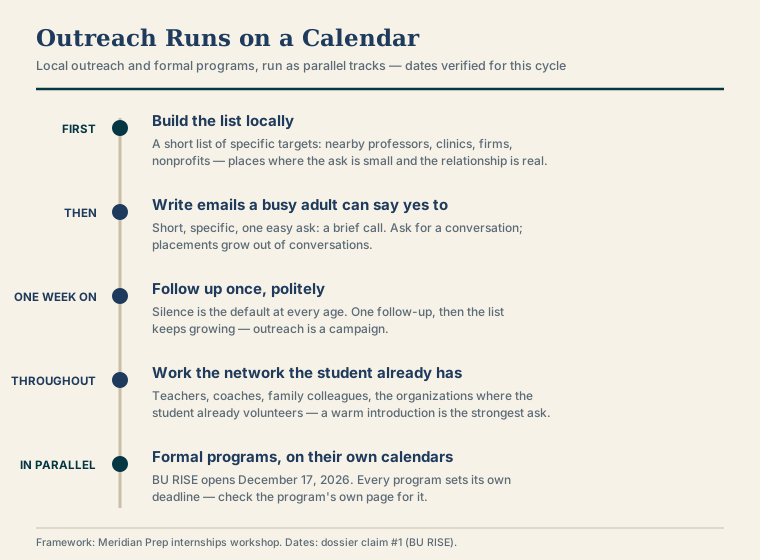
Build the target list locally first. Professors at nearby universities whose labs match the student's interests; local businesses, clinics, nonprofits, and engineering or law offices within commuting distance; organizations the student's community work already touches. Local and specific beats famous and far, because the ask is small and the relationship is close.
Write an email a busy adult can say yes to. Short. Who the student is: grade, school. The specific reason for writing to them: their lab's work, their firm's specialty, one sentence proving the message is no blast. What the student offers: hours, weeks, the skills in hand. And a small, easy ask: a brief call, or permission to send a one-page résumé. The common error is asking for "an internship" in the abstract. Ask for a conversation; internships grow out of conversations.
Expect silence, and plan for volume. Most cold emails receive no reply, from every sender, at every age. Write to the target list, follow up once, politely, after about a week, and keep building the list. The students who land placements treat outreach as a campaign, with a list, a follow-up, and a next target always ready.
Run formal programs as the parallel track. Structured research programs run on formal applications, and their windows open months before summer. Boston University's RISE is a six-week program for current juniors; its Internship track pairs a student with a mentor for an individual project in the mentor's lab at roughly 40 hours a week, in a session running June 27 to August 6, 2027. Applications for summer 2027 open December 17, 2026. Every program publishes its deadline on its own page; check there, and apply while local outreach runs. The two tracks hedge each other, and our guide to competitive summer programs applies the same three tests to the summer version of the question.
Work the existing network. Teachers, coaches, parents' colleagues, the organization where the student already volunteers: a warm introduction is the strongest form of the ask. That is how the working world functions, and learning to ask well is itself part of the education. A finished placement then feeds the rest of the file: the supervisor becomes the witness that the brag sheet that turns a supervisor into a recommender is built to serve.
Turning the Internship Into Application Value
The work is only half the asset. Documentation decides what it is worth in application season:
- Log it weekly: tasks, tools learned, numbers where they exist, problems solved.
- Secure the witness: before the last day, thank the supervisor and ask whether they would serve as a reference or write on the student's behalf where applications allow.
- Keep an artifact: the report, the cleaned dataset, the before-and-after — something that exists because the student was there.
The application version should read like work: what the student was trusted with, what improved, what would be done differently. That voice, specific, unglamorous, and proud of earned competence, is rare in a pile of applications, and activity descriptions that quantify impact shows how to give it the 150 characters the Common App allows.
The Tactical Playbook
- Run every opportunity through the three tests before accepting the title.
- Label shadowing as shadowing; save "internship" for work that passes.
- Build the local list of specific targets before writing to anyone famous.
- Draft the short email: identity, specific reason, concrete offer, one easy ask.
- Ask for a conversation; let the placement grow out of it.
- Sequence the campaign: list first, first round of emails second, one follow-up about a week later, new targets added throughout.
- Run formal programs in parallel: RISE applications open December 17, 2026 (an opening date); confirm each program's deadline on its own page.
- Log the work weekly, keep an artifact, and secure the witness before the last day.
Start in the Winter
Both tracks reward a winter start: outreach takes weeks to compound, and formal programs open their windows months ahead of summer. The target list and the outreach plan get built against the student's record: the interests already documented, the organizations already touched, the adults already able to make an introduction.
If an internship sits on your student's plan, we invite your family to schedule a free initial diagnostic consultation at meridianprep.com/contact.