Guide
The Congressional Award: The Honor Almost Nobody at Your School Knows About
Ask a room of ambitious juniors about awards and the same list surfaces: school honors, the big national competitions, the named scholarships. Almost nobody mentions the Congressional Award.
A strong file makes the point. Kason L. co-founded a nonprofit that has donated roughly 2,000 kits. He conducts independent research. He is on an Eagle Scout track. His file contains no mention of the Congressional Award — and that absence is instructive, because the award runs on a clock that rewards students who start early and returns no time to students who find it late.
The Congressional Award is Congress's award for young people — established by the Congressional Award Act, Public Law 96-114, in 1979 — and it is earned by setting personal goals in four areas and completing them over time. The program is non-partisan, voluntary, and non-competitive. It carries no GPA requirement. A participant meets a published standard, verified by adults, across months or years.
One rule governs entry, and it is the rule this guide turns on: hours count only from registration. Whatever a student has already built, the award can certify only the work that happens after that student registers for it.
The Four Areas
- Voluntary Public Service. Sustained service to a community — an ongoing commitment, measured in hours.
- Personal Development. A skill or pursuit grown deliberately outside the service context — for example, an instrument, a language, a craft, or a research discipline.
- Physical Fitness. A fitness goal set from wherever the student actually starts, pursued measurably. Progression is the standard.
- Expedition or Exploration. A venture into unfamiliar territory — a trip or exploration, sized by level from one day to five days and four nights.
Within each area, the student sets personal goals appropriate to a real starting point, works with an advisor, and has the work confirmed by validators in a record book submitted for review. Partial awards are not granted: all four areas must be complete at the level claimed.
The Levels, in Full
The figures below are the program's own, from its Program Book (v.19, for the 2026–27 cycle). Higher levels demand more — more hours, longer timelines, larger undertakings — and the structure is cumulative, so hours and months earned at one level count toward the next.
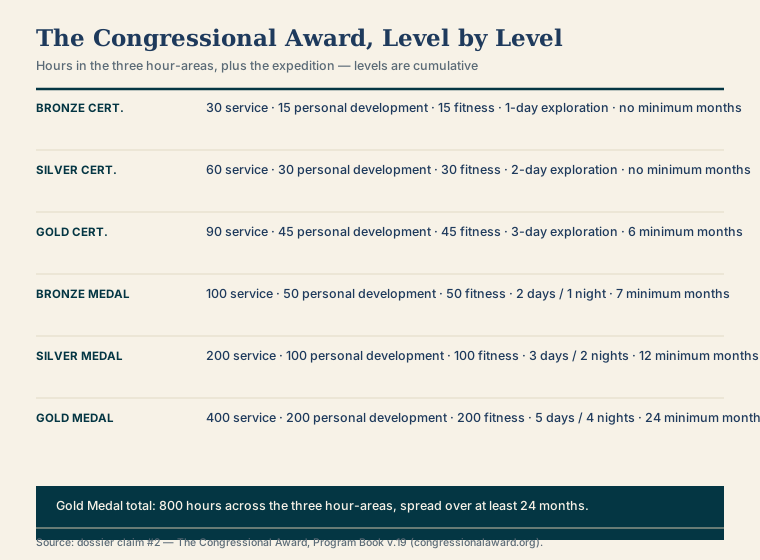
The certificate line runs from a Bronze Certificate — 30 service hours, 15 personal development, 15 fitness, a one-day exploration, no minimum months — through a Silver Certificate at 60, 30, and 30 hours with a two-day exploration, to a Gold Certificate at 90, 45, and 45 hours with a three-day exploration across at least six months. The medals run higher. A Bronze Medal takes 100 service hours, 50 and 50 in the other two hour-areas, a two-day, one-night expedition, and seven months of activity. The Silver Medal takes 200 hours of service, 100 of personal development, 100 of fitness, a three-day, two-night expedition, and 12 months. The Gold Medal takes 400 hours of service, 200 of personal development, 200 of fitness, a five-day, four-night expedition, and at least 24 months. Eight hundred hours in total, spread across two years at minimum.
Those numbers are the program's argument. A Gold Medal cannot be assembled in a semester, and two counting rules set the pace: a month counts only with at least one hour of activity inside it, and no more than eight hours of activity count in a single day.
What the Award Documents on an Application
The case for the award rests on what it documents. Three structural properties do the work.
The work is verified and sustained. Documented goals, logged progress, validators, a record book reviewed against the program's standards. A completed award is a paper trail of months or years of consistent effort across four dimensions of a student's life. It reads the way activity descriptions that quantify impact teach students to write: with counts attached.
The work is self-directed. The program is voluntary from the first goal to the last log entry: a participant sets the goals, organizes a life around them, and finishes. It is the national, certified cousin of the discipline in passion projects that get finished.
The award spans four areas at once. Service reinforces the community story. Personal development deepens a spike. Fitness and exploration round out the picture of a whole person. One completed award speaks to four parts of a student's narrative. Students deciding between building an organization and accumulating verified hours should compare starting a club vs. joining one, which applies the same evidence tests to a different structure.
The Registration Clock
One rule governs the whole strategy: hours count only from registration. A young person may register at thirteen and a half, and every level must be complete by the participant's 24th birthday. Service performed before registering — however genuine, however well documented elsewhere — earns nothing inside this program.
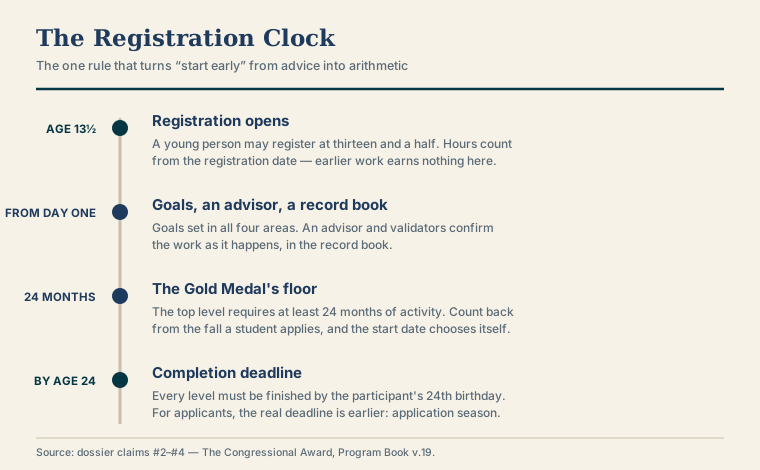
The arithmetic runs against application season. The Gold Medal requires at least 24 months of activity, and those months must elapse before the record book goes in — so a student who wants the Gold Medal on a fall application must be registered at least two years ahead: early in sophomore year on the months alone, with freshman year far safer. The lower levels remain reachable on shorter clocks — the Bronze and Silver Certificates carry no minimum months — and a certificate earned honestly is the right target when the calendar is short.
Goals hold best when they stretch from a real starting point and connect, where possible, to work already moving, so the hours accumulate inside a life the student is already living. The record book depends on a log kept from day one: hours, dates, what was done, who benefited.
The downside case is mild. A student who starts and accumulates a year of hours holds a year of service, skill-building, fitness, and one good adventure, whether or not a medal follows.
The Tactical Playbook
- Register first: eligibility opens at thirteen and a half, and hours count only from registration.
- Count back from application season: the Gold Medal needs 24 months minimum.
- Aim the level at the calendar honestly — a finished certificate beats an abandoned medal.
- Set goals in all four areas, stretched from the student's real starting point.
- Align goals with work already moving so hours accumulate inside the student's existing week.
- Choose an advisor and validators before the work begins.
- Log hours and dates from day one, in the record book, as the work happens.
- Write the application description from the log: hours, span, and what changed.
Start With the Clock
Award strategy is calendar strategy, and the Congressional Award's calendar is unforgiving in exactly one direction: time already spent cannot be registered retroactively. Award strategy starts by mapping a student's existing record against the four areas and the level the remaining calendar can honestly hold.
If an award like this fits your student's profile, we invite your family to schedule a free initial diagnostic consultation at meridianprep.com/contact.