
Guide
The 'Why Major' Essay: Connecting Your Story to Their Department
Neil G. had watched a great deal of medicine by the fall of his junior year.
He had shadowed in a veterans' hospital emergency department and intensive care unit. He had spent two weeks with a neurologist, rotated with a cardiologist, and finished a health system's shadowing program. Alongside the clinical hours sat a migraine study, built with a professor mentor and aimed at publication. His grades backed the ambition: a 4.0.
His counselor named the risk in that record plainly. Observation reads as tourism. A reader could finish Neil's file admiring his access and doubting his agency, because every experience on the page had happened around him. Other people diagnosed. Other people decided. He watched.
The repair, set in September of his junior year, turned watchers into authors. Brainstorm 10 to 20 capstone ideas. Frame each one as a hypothesis with a null hypothesis beside it. Pick the most distinctive. Build it to measure community impact with numerical data. The shadowing stayed in the file. The capstone would give that shadowing a question of its own — the spine of every why major essay Neil writes next fall.
That conversion — past work into a live question, a live question into a plan for a specific department — is the whole assignment.
A Major Is a Claim. Support It in Both Directions.
Weak why major essays declare a destination. Strong ones show a route.
The route runs backward first: coursework, research, jobs, and projects that point toward the field. Then it runs forward: the question that work left open, and the resources at this particular college for pursuing it. A reader who can trace both directions believes the major; enthusiasm alone asks that reader to take the student's word for it, a courtesy admissions readers extend sparingly.
Students still choosing between fields should settle the direction before drafting; how to choose a major walks through that decision using the transcript as evidence.
Where This Prompt Actually Appears
Colleges ask the question in different costumes, at very different lengths.
Rice University gives first-year applicants 150 words for its 2026–2027 prompt: "Please explain what draws you to the academic areas you selected above and how you hope to explore them at Rice University." Every sentence carries freight.
Cornell University's College of Human Ecology allows 550 words, and its prompt demands the full chain: think about an extracurricular, community engagement, or work experience that connects you to the college's mission and your intended major, describe what that experience taught you about your community and its needs, and explain how the intended major will help you make an impact. Cornell states its standard openly on the same page. Competitive candidates demonstrate "a strong, clearly articulated connection" between their interests and the program, a connection to the college mission, and an understanding of how the academic programs will support those interests, plus engagement that tests those interests through shadowing, internships, and service.
The University of Michigan asks applicants to describe the qualities attracting them to the specific undergraduate college or school they chose, and to explain how that curriculum would support their interests — 100 words minimum, 550 maximum. Michigan's own advice names the raw material: faculty, courses, and research opportunities.
California students meet the cousin of this prompt inside the UC application. Personal Insight Question 6 asks applicants to think about an academic subject that inspires them and describe how they have furthered the interest inside and outside the classroom, in a maximum of 350 words. UC's guidance asks whether the interest influenced a choice of major and how the student might pursue the subject at UC. Our field-by-field walkthrough of the UC application covers where that answer sits in the full file.
The pattern across all four: evidence first, institutional fit second. The word limits change. The logic holds.
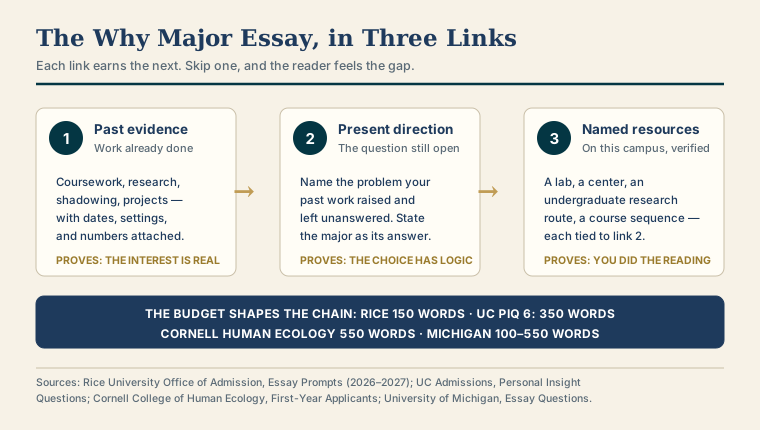
Build the Chain, Link by Link
The arithmetic shapes the work. Links one and two travel unchanged from school to school; link three does not. A ten-school list means ten separate link-three rebuilds, each verified on that department's pages.
Link one: past evidence. Inventory the record before drafting. Courses where the work came easily and curiosity lasted past the exam. Projects with an output somebody used. Jobs, shadowing, and research, each with a setting, a duration, and a number where one exists. Neil's inventory runs deep: the migraine study, the emergency department and ICU hours, two weeks with a neurologist. Depth gives him choices. A thinner record calls for building before writing — passion projects that get finished covers scoping a project small enough to complete before application season.
Link two: the present direction. Past work earns its place in the essay by raising a question. Neil's migraine study supplies his turn: a clinical subject he first encountered through shadowing becomes a research question with a mentor, a publication aim, and data attached; the capstone plan extends it toward community impact measured in numbers. That arc points toward a major where clinical questions meet measurement. State the direction as a question you intend to spend four years on. Vague destinations ("helping people," "understanding the brain") give link three nothing to attach to.
Link three: named resources. Name the exact resources you would use in your first two years: a laboratory or research center whose work matches your question, an undergraduate research program confirmed to accept students in your year, a course sequence building on the capstone you started. Verify each name on the department's own pages before you write it. Departments rename centers, retire programs, and restrict some opportunities to juniors and seniors. An essay naming a defunct program tells the reader the research happened once, quickly, and long ago.
Apply the swap test to link three. Replace this college's name with a peer institution's name. Sentences that survive the swap unchanged describe every school and persuade none. Rewrite them until the details belong to one campus only. This essay and its close relative get separated for a reason: the why us essay covers the whole institution, while the why major essay stays inside the department, its curriculum, and its research life.
The Tactical Playbook
- Inventory first: list courses, projects, jobs, shadowing, and research, each with a duration and a number where one exists.
- Convert observation into production before senior fall: one project with a hypothesis, an output, and measured results.
- Research each department on its own pages: curriculum, research routes, labs and centers, course sequences.
- Verify every named resource for current existence and for eligibility in your first two years.
- Budget by word limit: at 150 words, one proof and one resource; at 350 to 550, the full three-link chain.
- Run the swap test on every campus-specific sentence. Rewrite any sentence that fits a peer institution equally well.
- Align the essay with the rest of the file: activities, coursework, and the stated major should tell one continuous story.
- Draft one master version of links one and two; rebuild link three from scratch for each college.
Start With the Chain
In a first meeting, our counselors lay out a student's record as this chain and look for the weak link: rich experience with no question attached, a sharp question with thin evidence behind it, or a strong story pointed at resources nobody verified. Each weakness has a different repair, and repairs take weeks — this work belongs in junior year.
If your student's why major draft reads as enthusiasm in search of evidence, we invite you to schedule a free initial diagnostic consultation at meridianprep.com/contact. Bring the draft and the activity list. We will map the chain, link by link, and show you exactly where it holds and where it gives.