
Guide
The 'Why Us' Essay: How to Write One That Couldn't Be Sent Anywhere Else
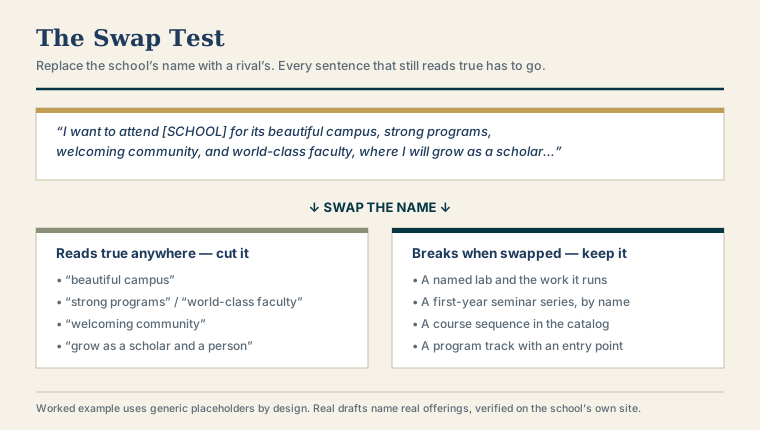
A senior brought in a finished "Why us" draft last fall, ready to send. It praised the school's beautiful campus, its strong programs, its welcoming community, its world-class faculty. Every sentence sounded warm. Every sentence sounded finished.
In the meeting, the counselor changed the school's name to the next school on the list and read the draft again. Nothing broke. The praise fit the second school as comfortably as the first, because none of it belonged to either one. Half the draft went into the margin — the half that could have been mailed anywhere.
That is the friction inside every "Why us" supplement. A college asks why the two of you belong together, sometimes in as few as 150 words, and most first drafts answer with praise any school could claim. The repair is reporting: specifics from catalogs, labs, and programs that exist at one school only.
The Swap Test
Here is the test; it takes ten seconds. Swap the school's name in your draft for another school on your list, then read again. Every sentence that still reads true has failed. "Beautiful campus," "strong programs," "welcoming community," "world-class faculty" — sentences built from praise survive any swap, and readers discard them on contact. A sentence earns its place by breaking under the swap: it names something the second school lacks, so it dies the moment the name changes.
Apply the test honestly and most first drafts lose half their sentences. Good. The survivors form the skeleton of an essay a reader remembers: only a student who did the homework could have written them. Our companion guide on why college essays carry this much weight in the file explains the reader's side: among qualified applicants, distinctive writing does sorting work grades have already finished.
The Evidence: Short Essays, Long Odds
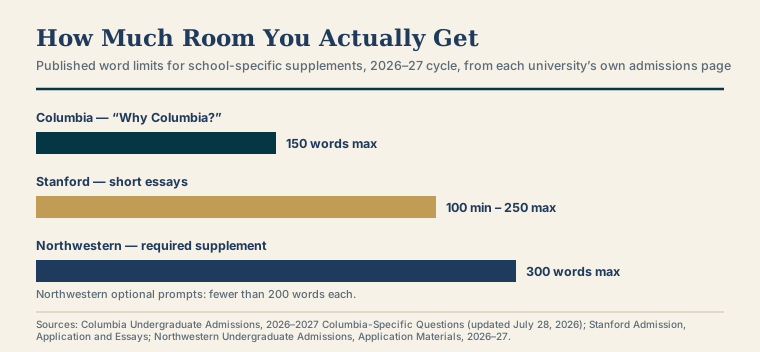
Start with the arithmetic. Columbia's 2026–2027 writing supplement asks, "Why are you interested in attending Columbia University?" and allows 150 words or fewer. Stanford gives its three short essays a floor and a ceiling, 100 words minimum and 250 maximum apiece, alongside short-answer questions capped at 50 words. Northwestern caps its required 2026–27 supplement at 300 words — a prompt about how background shapes engagement in its community — while the traditional why-Northwestern question sits in the optional set, each prompt held under 200 words. The "Why us" answer lives in a paragraph or two. Flattery has nowhere to hide at that length. Specifics have exactly enough room.
Jake C.'s file shows where those specifics come from. A 4.0 unweighted GPA. A 5.0 weighted GPA. An IB diploma in progress, plus dual-enrollment courses completed at UCLA and UCI. His counselor still rebuilt his list around programs, pairing each famous name with majors chosen for fit and odds: human culture, sociology, environmental design and stewardship. The plan set on October 22, 2026 treated prestige as the weakest currency in the file. Programs were the asset. Each recommended major connected to evidence already in his record: camp-counseling roles split into distinct activity entries, an international community project with quantifiable impact. Each school-specific claim needs a matching asset in the applicant's own file: a course sequence extending work the student has begun, a lab whose research continues a project the student can describe, a program track with an entry point the student qualifies to use. Claims without assets read as tourism.
Colleges publish how heavily the essay weighs in their decisions; the Common Data Set records those ratings in a standard format. The supplements themselves live inside the Common App as college-specific questions, with each school setting its own prompt and limit. Every prompt is visible by late summer; fall weekends still run out before the research does.
Mining the Catalog: Three Seams
Specifics come from documents colleges publish for enrolled students. Applicants rarely open them. Readers can tell.
The course catalog. Read the actual listings for the department you hope to join, first-year offerings included. Course titles, sequences, and prerequisites reveal how a school teaches a subject: the order it insists on, the methods it favors, the point where coursework turns into research. A strong essay cites a sequence: this introductory course, then that methods course, then the seminar where the work becomes original. Two or three linked courses, described accurately, outweigh a paragraph of adjectives.
The labs and centers. Research groups publish their projects, people, and openings. An applicant who can describe a named lab's current work, connected to a project of their own, hands the reader evidence of seriousness. Keep the connection concrete: the technique you learned, the question your project left open, the method the lab uses to pursue it.
The programs and tracks. First-year seminar series, residential programs, undergraduate research tracks, combined-degree pathways: structured programs give an essay its plot. Each one has an entry point, a cohort, and a sequence of experiences, so naming one lets you write forward — where you enter, what you do second, what the experience builds toward.
One discipline governs all three seams: verify every name on the institution's own site before it enters the draft. Programs get renamed. Labs move. A specific that turns out to be wrong — or worse, borrowed from another school's pages — damages the file far beyond one supplement.
Pair It With the Major Story
Colleges often split the question in two: why the school, and why the field. Columbia pairs its "Why Columbia?" question with a prompt about preferred areas of study, each capped at 150 words. Treat the pair as one argument in two rooms. The school essay covers place: programs, labs, sequences, communities that exist there alone. The major essay covers appetite: the questions you bring and the preparation behind them. Students still settling the field should start with how to choose a major; those with the field settled should read the 'Why major' essay and draft the pair together, so the answers reinforce each other and repeat nothing.
The Tactical Playbook
- Run the swap test on every draft: swap in a rival's name, then cut or rewrite every sentence that still reads true.
- Build a research sheet per school: three catalog courses in sequence, one named lab with its current work, one structured program with its entry point.
- Verify each specific on the school's own site — catalog, lab page, program page — and record where you found it.
- Connect every school specific to an asset already in your file: a course taken, a project finished, a role held. Drop specifics you cannot connect.
- At 150 words, two specifics developed well beat five named in passing. Budget every draft by its official limit.
- Draft the "Why us" and "Why major" answers as a pair; assign place to one and appetite to the other, with zero repeated sentences.
- Search the finished draft for the wrong school's name, the wrong mascot, and the wrong city. This error happens every cycle.
- Read the essay aloud once. Sentences you stumble over are sentences a reader skims.
Start With the Research Sheet
The "Why us" essay rewards students who treat it as reporting. A blank page usually means an empty research sheet, and an hour in a course catalog fixes that faster than an afternoon of staring. Our team builds those sheets with seniors every fall: programs worth naming, claims each file can support, swaps each draft must survive.
If you are writing supplements this season, we invite you to book a free initial diagnostic consultation at meridianprep.com/contact. Bring your college list and one current "Why us" draft. We will run the swap test together and show you, sentence by sentence, what an admissions reader sees.