
Guide
UC PIQ: The Leadership Experience Prompt, Explained
Kason L. arrived at his intake with a 4.0 and a problem of arrangement. His record was strong and scattered — varsity Science Olympiad, 8th at state; independent research detecting 6PPD and 6PPD-quinone contamination in water and tire samples; Mock Trial treasurer, over $3,000 raised — and it stayed silent on who relied on him. The reliance showed on delivery days: daycares and YMCA sites expecting the hygiene kits his children's dental-health nonprofit had promised, a volunteer crew working to his packing schedule.
The audit found the spine in the least decorated line of the file. Kason L. had co-founded that nonprofit, which has donated roughly 2,000 hygiene kits through daycares, the YMCA, and community organizations serving children in care. Two thousand kits represent a supply chain: sourcing, packing, scheduling deliveries, recruiting the next pair of hands when a volunteer graduated. That work ran over time, and other people organized their effort around his. On the University of California application, this was the leadership story.
The Thesis: Readers Score Influence
UC publishes the leadership prompt as Question 1 of eight:
> Describe an example of your leadership experience in which you have positively influenced others, helped resolve disputes or contributed to group efforts over time.
Read the verbs. Influenced. Resolved. Contributed. The prompt asks what changed for other people because you were in the room, over time. A title can open the story. Evidence carries it: decisions you made, people you trained, a dispute you worked through, a numbered result. Our overview of the UC Personal Insight Questions as a full set covers choosing your four.
The Format, Exactly as UC Publishes It
First-year applicants respond to 4 of the 8 questions. Each response carries a maximum of 350 words. UC gives every question equal consideration. The same four answers go to every campus you select. A walkthrough of the UC application field by field maps the rest of the file.
UC's writing guidance runs direct: use "I" statements, build on specific, concrete examples, save finished answers in plain text before pasting them in — and expect a list of accomplishments to lessen the impact of your words. Robert Penman, who leads undergraduate admissions at UC Davis, told UC's newsroom that strong responses read direct, like a conversation, with no reader preference among the eight. Plan for plain first-person prose: your actions, your reasoning, your result.
What UC Counts as Leadership
UC's published guidance for this prompt, under "Things to consider," defines the role broadly. Leadership can mean mentoring others, acting as the person in charge of a specific task, or taking the lead role in organizing an event or project. UC asks what your responsibilities were, whether you led a team, how the experience changed your perspective on leading others, and whether you helped resolve an important dispute at your school, church, in your community, or in an organization. UC closes with family: helping out or taking care of your family counts, and leadership reaches beyond school activities.
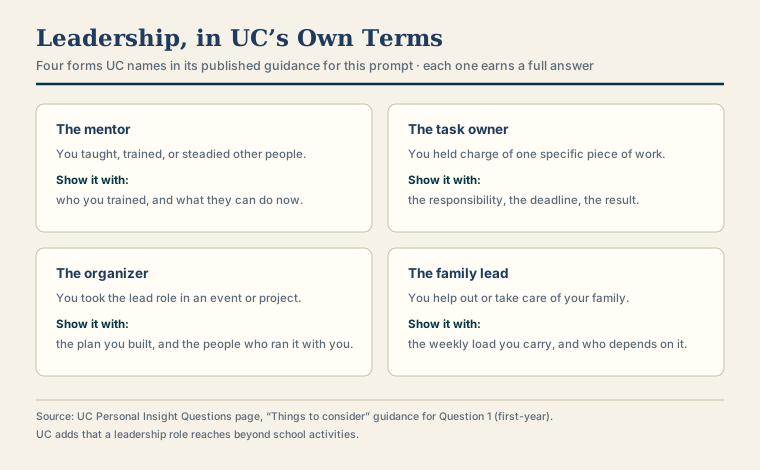
That breadth widens the candidate pool. The junior who trains new members of a research team has material. So does the student who runs a group's schedule or supply closet, and the eldest sibling who holds a household routine together every weekday afternoon. Kason L. fits the organizer form: the co-founder title mattered because the distribution system underneath it kept running, month after month, for partners depending on the deliveries.
The Evidence: One Story, Three Legs
A strong leadership answer rests on three legs.
The anecdote. Pick one group effort with a timeline. Kason L. could open inside a packing session or a delivery day, with a partner site expecting kits and a volunteer crew to organize. One scene shows your responsibilities in action.
The numbers. Roughly 2,000 kits donated. Deliveries routed through daycares, the YMCA, and community organizations. A treasurer stint that raised over $3,000 in a second activity. Numbers let a reader measure influence instead of taking your word for it. The same discipline powers your activity entries — see how to write activity descriptions that quantify impact: the PIQ tells the story, the activity line carries the count, and the two agree.
The policy. UC's own guidance supplies the frame. Mentoring counts. Owning a task counts. Organizing counts. Family responsibility counts. When your experience matches a form UC names, let the details say so, and spend your reflection on what the work taught you about leading others.
The Captain Clichés Readers See Every Week
Team-captain material sinks this prompt in predictable ways. Each pattern drains the same resource: proof of influence.
- The election opener. The answer begins with winning the title and spends its middle on meetings chaired. Your decisions stay offstage.
- The trophy paragraph. Scores, placements, and awards fill the space where people should be. An 8th-place state finish in Science Olympiad belongs in the awards list; readers want the teammates you steadied before the tournament.
- The one-meeting dispute. Two teammates argue, you speak once, harmony returns by Friday. UC asks about group efforts over time, so give the disagreement a history and your part in the repair a sequence of steps.
- The vanishing "we." Every sentence starts with "we," and your contribution blurs into the group's. UC instructs applicants to use "I" statements for exactly this reason. Claim your actions in the first person, and credit teammates for theirs.
Spend 350 Words Like a Budget
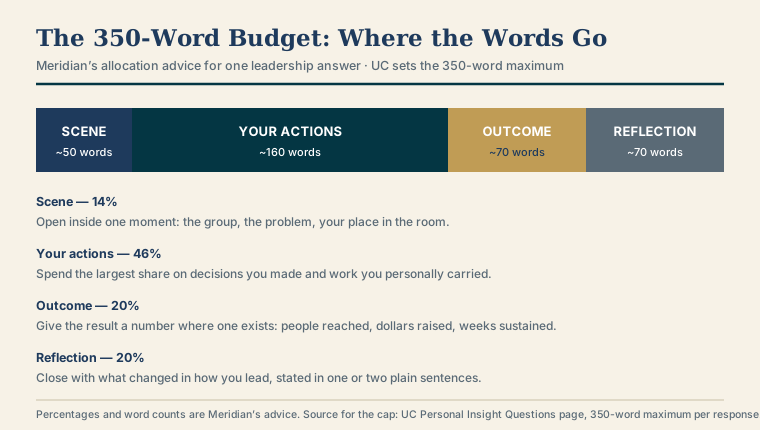
Open inside one moment for roughly 50 words: the group, the problem, your place in the room. Give your actions the largest share, around 160 words — the choices you made, the people you organized or trained, the dispute you worked through. Reserve about 70 words for the outcome, with a number where one exists. Close with roughly 70 words of reflection: what you learned about leading others, and what you do differently now. These proportions are Meridian's advice. UC sets only the ceiling.
A leadership story built around a hardship can tempt you toward the UC PIQ challenge prompt. Give each story one home. The leadership answer foregrounds your influence on the group; the challenge answer foregrounds the obstacle and your response to it. Duplicated material spends two of your four slots on one dimension of your file.
The Tactical Playbook
- Choose one group effort that ran over months, with people who depended on your part in it.
- Name your exact responsibilities in the first three sentences.
- Write in the first person. Use "I" for your actions and credit teammates by name or role for theirs.
- Attach a number to the outcome: kits delivered, dollars raised, members trained, weeks sustained.
- Show one dispute or friction point and the steps you took, in sequence.
- Match your story to a form UC names: mentor, task owner, organizer, or family lead.
- End on what changed in how you lead, in one or two plain sentences.
- Save the final answer in plain text, paste it into the application, and proofread in place.
Bring the Draft You Have
In a free initial diagnostic consultation at Meridian Prep, we read a leadership draft the way UC readers describe reading: for your specific actions, your influence on other people, and the evidence that the work lasted. We mark where a title does the work a decision should do, and rebuild the word budget around your strongest scene.
If your leadership answer currently reads as a list of roles, bring it in. Schedule your free consultation at meridianprep.com/contact, and bring the activity list alongside the draft so the numbers match.