
Guide
UC PIQ: The Significant Challenge Prompt, Explained
Shourya C. had a numbers problem he could recite from memory. He was a senior with a 3.1 unweighted UC GPA. His early drafts had a second problem, quieter and more damaging: they leaned on self-praise and awards, listing what he had won and saying little about how he worked, what he had gotten wrong, or whom his work served.
His counselor rebuilt the approach from material underneath the trophies: community impact at the center, failure and iterative design as the growth engine, his immigrant family's cultural pressure. A genuine character flaw stayed in. Achievements stayed, too, as platforms — evidence he could do the work. Then came the exercise that produced his angle: write 50 variations of his community issue. Fifty. Most went into the discard pile. A few reached an honesty the polished drafts had avoided, and he developed those in weekly workshops over six weeks.
That rebuild holds the method for this prompt: significance emerged from the working material — pressure, a flaw, repeated attempts, a community that felt the result.
The Prompt, Word for Word
Prompt 5 of the UC Personal Insight Questions reads: "Describe the most significant challenge you have faced and the steps you have taken to overcome this challenge. How has this challenge affected your academic achievement?"
The mechanics are fixed. You answer 4 of 8 questions, each response capped at 350 words, and UC states that all questions receive equal consideration. UC's guidance allows a wide field: a challenge "could be personal, or something you have faced in your community or school." UC asks why the challenge was significant to you, what you learned, and whether you had support or handled it alone. An unfinished challenge qualifies: UC invites students still working through one to describe what they are doing now and how it touches home, school, and family.
Read the prompt as three assignments in sequence. Name the challenge. Detail the steps. Account for the academic effect. The third assignment carries the most weight, and drafts most often shortchange it.
What "Significant" Actually Means
Significance lives in consequence. A challenge earns this prompt when it changed your schedule, your grades, your course choices, your responsibilities, or your capacity for schoolwork — and when your response to it reveals how you operate. Significance shows in the decisions that stay visible from first paragraph to last.
Apply two tests before you commit. First, the academic test: can you point to a concrete effect on your achievement — a grade pattern, an attendance stretch, a dropped or added course, a rebuilt study system? The prompt asks that question outright, so a vague academic thread leaves a third of the assignment blank. Second, the agency test: did you take steps a reader can follow? Help you requested, routines you built, work you took on, a plan you revised after the first version failed. Steps give the reader your character in motion.
Scale works for you here. A family obligation carried every weekday for two years can outweigh a single dramatic month, because duration exposes your systems. Choose the challenge where your response shows the most. No prompt outdraws another: UC reports response rates running fairly evenly across all eight questions (Penman, UC newsroom).
One caution on selection. Leadership material sometimes gets forced into this prompt. Keep the categories clean: if your material centers on influencing a group over time, our guide to the UC PIQ leadership prompt covers that ground. This prompt belongs to the obstacle and your answer to it.
The Hardship Trap
Every fall, strong students write challenge answers that read as case files: a long account of what happened to them, rendered in painful detail, with the response compressed into a closing sentence about resilience. The suffering is real. The answer still fails, because the reader finishes it knowing the event and guessing at the applicant.
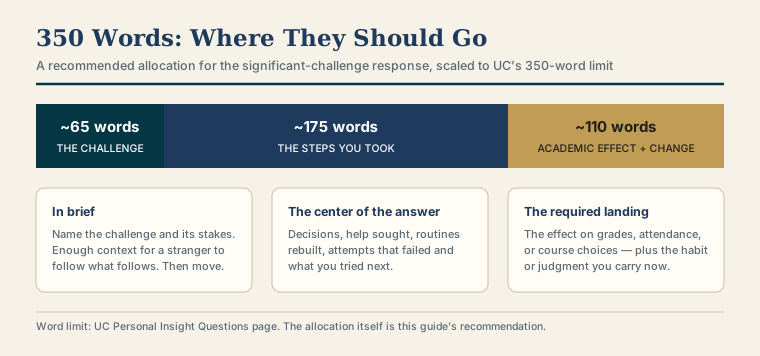
Proportion is the discipline. Give the challenge enough space for a stranger to grasp the stakes — usually a few sentences — and turn to your steps while the reader still has room to follow them. Graphic detail earns nothing. Chronology earns little. Select the details that explain your decisions, and let the rest stay private. Understanding your situation requires far less than the full record.
Tone matters as much as proportion. State hard facts plainly, in the same register you would use for any other fact in the file. UC's general writing guidance points the same direction: use "I" statements, build on specific, concrete examples, and remember that a list of accomplishments lessens the impact of your words. Plain statement carries weight.
An ongoing challenge deserves the same restraint, plus one addition: show the current system. UC welcomes answers from students still working through a challenge. Describe what you are doing now, what it costs, and how your schoolwork looks inside those conditions.
Keep the Additional Comments Box in Its Own Lane
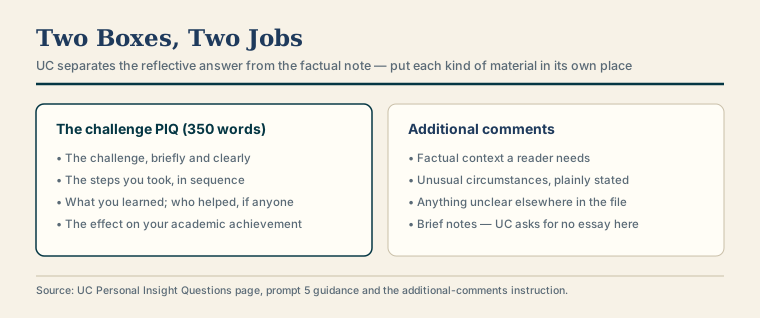
Students often ask where difficult context belongs: this answer, or the additional comments field. UC draws the line in its own words: "This shouldn't be an essay, but rather a place to note unusual circumstances or anything that might be unclear in other parts of the application."
Additional comments hold facts: the school closure, the semester of caregiving, the grading anomaly, the circumstance a reader needs before judging the transcript. The challenge PIQ holds your reflective account of one obstacle: your steps, your learning, the academic effect, in your own voice. A circumstance can appear in both places, in different forms — a factual line in the comments, a developed answer in the PIQ. Duplicating the same paragraphs in both wastes one of the two. Our walkthrough of UC additional comments covers what belongs there and how brief to keep it.
Students applying to private colleges face a different temptation: importing the Common App personal statement. The forms reward different things, and the overlap produces answers that fit neither. The overlap errors are catalogued in our guide to Common App personal statement mistakes.
The Tactical Playbook
- Run the two tests on one challenge before drafting: a concrete academic effect, and steps a reader can follow in sequence.
- Budget the 350 words before you write: roughly 65 on the challenge, 175 on your steps, 110 on the academic effect and what changed.
- Open with the challenge stated plainly. Reach your first step by the third sentence.
- Name the help you used. UC asks whether you had support or handled it alone; either answer works when it is specific.
- Quantify where the record allows: hours worked, weeks missed, courses retaken, grades before and after.
- Write an ongoing challenge in the present tense of management: what you do now, what it costs, how schoolwork proceeds.
- Place factual context in additional comments; keep the PIQ for your response and reflection.
- Mark every sentence in the final draft as challenge, step, or effect. Long unmarked stretches need cutting.
- End on a present-day habit or judgment the challenge produced. Readers remember the person you became in the final lines.
Talk Through Your Four Answers Before November
Choosing a challenge, calibrating how much hardship to include, and landing the academic effect in 350 words is exacting work. A free initial diagnostic consultation at Meridian Prep starts with exactly this material: we read your drafts against the prompts you chose, test each challenge for academic effect and visible steps, and map the revisions that matter most before you file.
If your challenge draft reads as a long account of what happened, bring it in. Schedule your free consultation at meridianprep.com/contact, and we will help you rebuild it around your response.