
Guide
UC Additional Comments: What to Write — and What to Leave Blank
Sachin S. had a transcript with a hole in it.
He was a senior applying for mechanical engineering, carrying a 3.6 unweighted GPA, and one line refused to blend in: an F in Math Analysis Honors, second semester of the prior year. The F had arrived during a stretch of family health hardship, while Sachin was carrying caretaking responsibilities at home. He retook the course and earned an A.
At his September meeting, his counselor treated the F as two separate problems. The first was arithmetic. The second was reading. UC's grade rules would handle the arithmetic on their own. The reading — a stranger scanning the file, meeting the F with no context attached — needed Sachin himself, in a small box most applicants either ignore or overfill.
That box, and its twin later in the application, reward precision. Used carelessly, they spend a reader's patience on material the file already contains.
Two Boxes, Two Sizes, Two Jobs
The UC application gives first-year applicants two additional-comments boxes. They sit in different sections, serve different purposes, and their limits differ by an order of magnitude. Confusing them is the most common error we see.
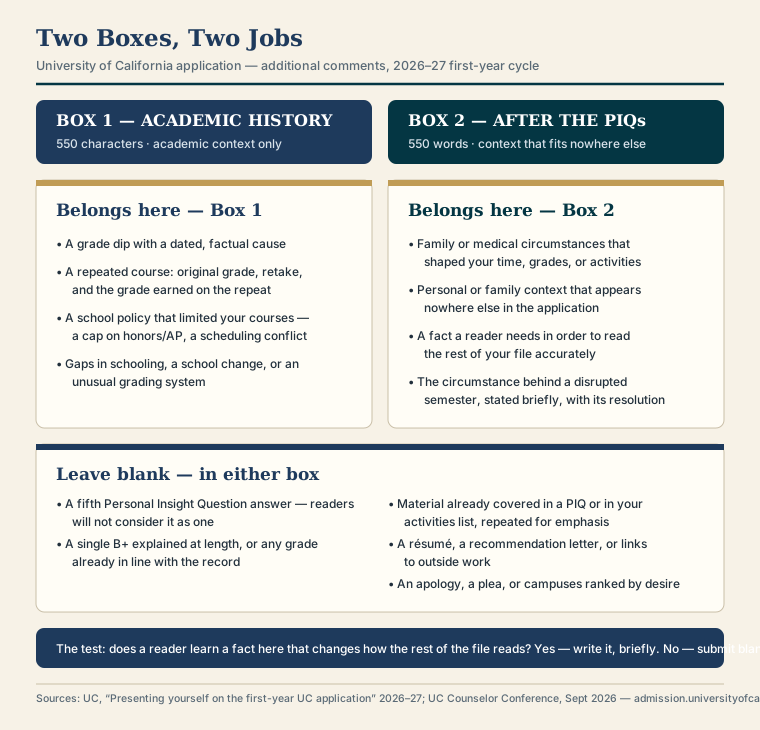
The first box closes the Academic History section. UC's 2026–27 first-year application guide describes it as the place for information that helps a reader understand your academic context and history, and sets the limit at 550 characters. Characters. That allowance covers roughly 90 words. Its intended subjects: gaps in education, transitions between schools, grading-system explanations, poor grades and repeated courses, school policies that shaped class choices.
The second box follows the Personal Insight Questions. UC calls it a second opportunity for additional comments, for information that appears nowhere else in the application. Its limit is 550 words. UC's counselor materials draw the boundary plainly: the box should not serve as a fifth PIQ response, and readers will not consider it as one.
A full walkthrough of where each section sits lives in our field-by-field guide to the UC application, and our guide to the additional information section covers the same judgment calls for applications beyond UC.
What the Grade Rule Already Does for Sachin
Start with the arithmetic, because families routinely explain a problem that UC's own calculation has already solved.
UC requires applicants to report every attempt at a course, the original grade and the repeat alike. For the GPA calculation: when the exact course in which a D or F was earned is repeated and the repeat earns a C or better, UC excludes the original grade from the GPA calculation. Course validation is a different route — a higher-level math or world-language course that clears the deficiency — and on that route both grades count in the calculation.
Sachin's file follows the exact-course pattern. The F stays visible on his application — UC asks for the full record, and admitted students have their self-reported grades checked against official transcripts. The A from the retake carries the weight in his UC GPA. His 3.6 unweighted average blends every course together and understates how UC's own math treats the recovery.
So the comments box owed his reader a different piece of information: the circumstance, briefly. A family health hardship during that semester, caretaking duties at home, a course retaken the following term with an A earned. Dates, facts, resolution. Three or four sentences in the 550-word box. That division of labor — short box for the academic fact, long box for the human context — suits any file with a repaired grade in it.
Why This Space Carries Extra Weight at UC
At most colleges, a counselor's letter explains a bad semester. A teacher adds a sentence. UC removes those voices from first-year review.
UC instructs applicants to leave letters of recommendation out of the application. A campus may request letters later in a supplemental review — UC Berkeley invites a small share of applicants to submit up to two — and students respond only when a campus asks. For most applicants, the file arrives with a single author. Every explanation in it comes from the student, or it comes from nobody.
That structure raises the stakes on these two boxes: they hold the only context a reader will receive about a disrupted semester, a school that capped honors enrollment, a job that consumed the hours other students gave to clubs. Our UC application checklist sequences this work alongside the rest of the filing.
Where Good Intentions Turn Into Excuse-Making
Readers can tell the difference between context and advocacy. Context supplies facts the file lacks: what happened, when it happened, how long it lasted, what changed afterward. Advocacy argues with the reader about how a grade should feel. The first kind earns trust. The second kind spends it.
Three habits mark the advocacy version. Length comes first — a 550-word entry about a single B+ announces its own disproportion. Repetition comes second: restating a hardship already handled well in a PIQ answer weakens both pieces. Tone comes third. Apologies, promises about future performance, and rankings of campuses by desire all ask the reader for something. Context asks for nothing. It hands over a fact and stops.
Sachin's draft stayed on the right side of that line by staying short. His hardship already had a natural home as background in one of his PIQ answers, where our guide to the UC Personal Insight Questions would place the fuller story of what caretaking taught him. The comments box carried the spare factual version: the semester, the circumstance, the retake, the A. Each section did one job.
The Tactical Playbook
- Sort by box, and size to the box. Academic facts — repeats, gaps, grading systems, course limits set by your school — go in the 550-character Academic History box; draft to roughly 90 words or fewer and count characters before pasting. Personal and family context goes in the 550-word box after the PIQs, overflow context included, with a one-line pointer connecting the boxes.
- Apply the reader test. Write a comment only when a reader would form a wrong impression without it. A transcript anomaly, a missing course your school never offered, a semester that breaks an otherwise steady pattern: write. A record that speaks clearly on its own: submit blank.
- Report both grades, always. Enter the original D or F and the repeat exactly as your transcript shows them. For an exact-course repeat passed at C or better, UC excludes the original grade from its GPA calculation; validation routes count both grades. UC verifies self-reported grades for admitted students.
- Use the four-part shape. What happened. When. What it affected. Where things stand now. Four short movements, plain sentences, dates included.
- Give each fact one home. Material covered fully in a PIQ answer or an activities entry stays there. The comments box adds new information.
- End at the resolution. Close with the outcome — the retake completed, the grade earned, the schedule restored.
- Read it aloud as a stranger. If the entry sounds like an argument, cut it in half and keep the facts. If it sounds like a note from a school office, you have the register right.
A Blank Box Is a Finished Box
Plenty of strong UC applications submit with both boxes empty. A steady transcript, a course list that explains itself, PIQ answers that carry their own context — that file needs no appendix. Blank signals a record with nothing unexplained, and readers move on to the parts of the application built to persuade them.
If your file carries a semester like Sachin's, the decision deserves a second set of eyes before the November 30 deadline. Bring the transcript and your draft comments to a free initial diagnostic consultation at Meridian. We read the anomaly the way a UC reader will, check the entry against the box it belongs in, and tell you plainly whether to write, shorten, or leave the space blank.