
Guide
The Additional Information Section: What Belongs There (and What Backfires)
Olivia L. had a gap she wanted to explain. Her diagnostics had climbed all year: 1300 on October 1, 2025, then 1350, then 1380, then 1470 on March 8, 2026. Her three official SATs refused to follow: 1310 on December 6, 2025, 1330 on March 9, 2026, and 1280 on March 14, 2026. Her best official score trailed her best diagnostic by 140 points, and her family felt the pull every applicant family feels at that moment — put the explanation in writing before a reader draws the wrong conclusion.
The Common App offers an inviting place to do it: an optional box labeled Additional Information, at the end of the Writing section. For Olivia, it would have been a trap.
Colleges see official scores only. Practice results live in a prep log; readers never encounter them. A paragraph describing strong diagnostics and disappointing test days would introduce a weakness the file itself keeps invisible, then argue with it. The score decision — which sittings to report, school by school, under each college's testing policy — belongs to a different analysis, the one in our guide to whether to submit or withhold test scores. Olivia's box stays empty. Her file reads cleaner for it.
The Thesis: A Footnote With a Word Limit
The Additional Information section answers one question, in Common App's own wording: "Would you like to share any additional details or qualifications not reflected in the application?" The section collects stray facts and carries context a transcript cannot carry on its own. Voice, narrative arc, and self-revelation belong to the personal statement, and our guide to common personal statement mistakes covers what happens when the two genres trade places.
Common App has now enforced that reading with arithmetic. Effective August 1, 2025, the section's maximum dropped from 650 words to 300, and the limit holds for the 2026–27 cycle. Common App published its reasoning alongside the change: across the five most recent cycles, the average response ran below 300 words and the median ran below 200. The long entries were the problem entries — padded, repetitive, essay-shaped. The constraint does the editing for you: name the fact, date it, state where things stand, stop. And the box stays optional: readers treat a blank box as a complete application with nothing stray to report.
Two Boxes, Two Jobs
Challenges and Circumstances (250 words). Hardship lives here: family disruptions, housing instability, health events, caregiving obligations, a lost quiet place to study. This question replaced the COVID-era Community Disruption question on August 1, 2025 and covers disruption in general. Additional Information (300 words). Everything else a reader needs lands here: transcript mechanics, schedule facts, activity detail that outgrew its field. The second box then holds the facts around the hardship — semester dates, courses affected, the arrangement your school made. Tell a story twice and you waste both boxes.
California applicants should note that the UC application runs its own system; our guide to the UC additional comments section maps where context goes there.
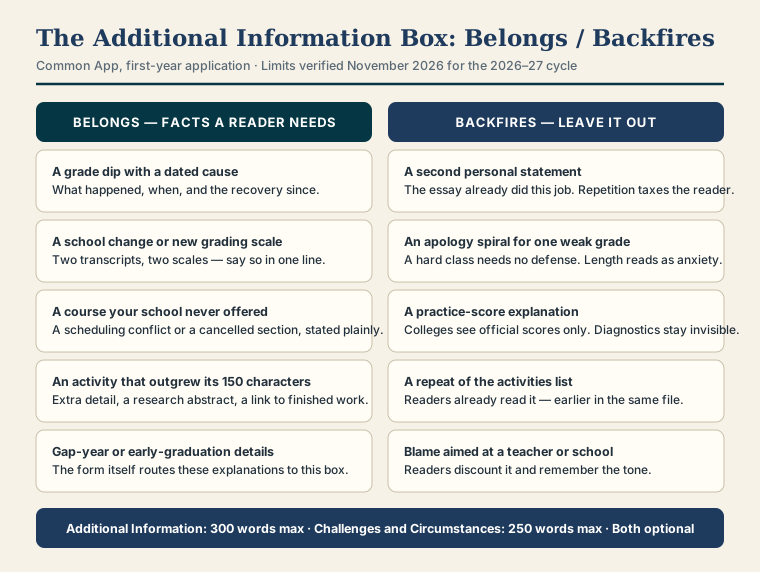
What Belongs
A grade dip with a dated cause. One semester sags because a parent lost a job, a grandparent died, a diagnosis arrived in October and treatment began in November. The reader sees the sag either way. Three factual sentences — what happened, when, what the record shows since — let the reader price it correctly.
A disrupted semester or a school change. A midyear move produces two transcripts with two grading scales. A term lost to a school closure, a year split across countries: each leaves a visible seam. One line per seam closes it.
A course that never happened. Your school cancelled the second year of a language. Readers cannot see an empty chair. Tell them the chair was empty.
An activity that outgrew 150 characters. The activities list gives each entry a tight description field. A research project with a real abstract, a business with actual revenue mechanics, a portfolio that needs a link — the overflow belongs here, briefly, link included.
Administrative facts the form itself requests. Applicants who graduated early or late, took time off, or spent a gap year get routed to this box by the application's own instructions. Answer in a sentence or two.
What Backfires
A second personal statement. A spare essay about leadership or resilience duplicates the personal statement's assignment and signals doubt about the first essay. Readers grade the box as information. Prose written for admiration earns none here — see why college essays carry the weight they do.
The apology spiral. A single B in a hard course, defended across 200 words, teaches the reader to stare at the B. Absent a circumstance, a hard class is a hard class.
The practice-score explanation. Olivia's case, generalized: any argument built on evidence the reader cannot see — diagnostics, informal praise, a score from a test the college declined to consider — asks the reader to trust a claim while discounting the record.
A repeat of the activities list. Restating ten activities in paragraph form adds length and subtracts nothing else. The reader read them eight screens earlier.
Blame. A paragraph faulting a teacher's grading may feel accurate from inside the semester. On the page it reads as temperament. State the mechanical fact; let the counselor's letter handle institutional color.
Your Counselor Carries Half of This
School-side context has a designated author: your counselor. Through the School Report and the school profile, your counselor supplies the frame readers use for every transcript from your school — grading scale, courses offered, any cap on advanced classes. The counselor's letter can add context for a student's performance and involvement, including family situation and after-school obligations.
That division of labor shapes your draft. A fact your counselor will state — the school dropped a course, the building closed for a month — needs one pointing sentence from you at most. A fact only you can state — the dates of a family disruption, the hours of a caregiving shift — needs your sentences, plus a heads-up to your counselor so the letter corroborates rather than collides. Coordinate early: a two-line email in September beats a surprise in December.
The Tactical Playbook
- Run the blank test first: name the specific fact a reader would misread or miss without your note. No fact, no entry — leave the box empty.
- Sort the fact: hardship to Challenges and Circumstances (250 words); transcript mechanics, schedule facts, and activity overflow to Additional Information (300 words). Each fact appears once.
- Write the three-sentence version first: what happened, when it happened, what the record shows since. Most strong entries end near there.
- Keep the register flat: dates, course names, semester labels. Save adjectives for the personal statement.
- Cut every sentence that repeats the activities list, the personal statement, or the other optional box.
- Give your counselor the note before you submit. Ask two questions: does the letter already cover this, and do the dates match?
- Check the current limits inside your own application before pasting: 300 words and 250 words for 2026–27.
- Read the finished entry aloud once. It should sound like a footnote read by a registrar — the register this section rewards.
A Second Set of Eyes, Before the Box Decides for You
The hardest Additional Information call is the empty one. Olivia's family needed a counselor willing to say that silence served her file better than a well-written paragraph. Families facing a genuine dip or a disrupted semester face the opposite call, and the discipline matters just as much.
That judgment is where we start. Meridian offers a free initial diagnostic consultation at meridianprep.com/contact, and families are welcome to bring the exact draft they are considering — or the empty box they are worrying over. We will tell you plainly which facts belong in writing, which belong to your counselor, and which belong nowhere at all.