
Guide
The UC Application Checklist: Final Checks Before You Submit
Aahana R. had the kind of file admissions offices describe with approval: a 1480 on the SAT (770 reading and writing, 710 math), AP scores of 5, 4, 4, and 5, a deep record of activities built over years. When her counselor sat down with the file in July, the conversation went to a single line in her senior-year schedule: standard Calculus, where AP Calculus should have been.
The backstory sat in her junior year: a C and a B in accelerated pre-calculus had pushed her off the faster math track, and the senior plan had absorbed the downgrade. She was weighing biology, biomedical engineering, and neuroscience; her father wanted computer science kept open. The counselor's assessment was blunt. For competitive STEM programs at the mid- and upper-tier UC campuses, AP Calculus — or a completed college-level calculus course through a community college, BYU Online, or UC Scout — was the price of admission to the conversation. Without it, biomedical engineering was unlikely at any UC campus. A floor of eight weighted courses framed the discussion.
The rigor line carried all of the weight. Her 1480 carried none: UC gives the SAT no role in admission or scholarship decisions.
The errors that cost UC applicants are quiet ones: a course title entered wrong, a rigor gap nobody named until senior fall, an activities list ordered by habit. Students notice them after submission, when the academic history accepts no edits in the portal. Drafting builds the file. The final two weeks belong to the audit.
Start With the Calendar, Because the Date Has Moved
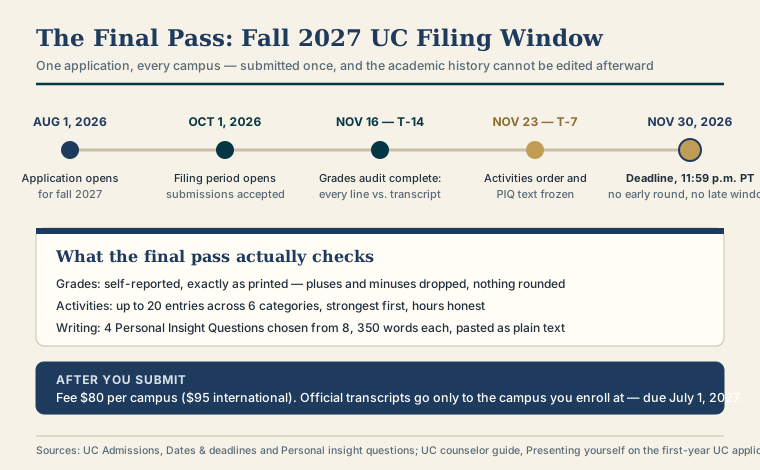
For fall 2027 entry, the application opened August 1, 2026, and filing runs October 1 through November 30, 2026. The deadline is Monday, November 30, at 11:59 p.m. Pacific Time.
Seniors will encounter a December 1 date in older guides — a leftover from UC's fall 2026 extension. The published fall 2027 calendar says November 30.
UC reads applications after filing closes, so an October submission earns no advantage over a late-November one. Spend the weeks on verification and submit days early: grades audit by November 16, activities and essays frozen by November 23, submission by November 27 or 28.
The Grades Audit: Read Your File the Way UC Rebuilds It
UC never sees your school's GPA. It rebuilds one from A–G courses taken from the summer after ninth grade through the summer after eleventh grade. Pluses and minuses vanish — a B+ and a B− both enter as a B. Each semester of a UC-approved honors, AP, or IB course graded C or better earns one extra point, capped at eight semesters — four at most from tenth grade. For nonresidents, honors weight counts AP and IB courses only. The eligibility floor is 3.0 for California residents and 3.4 for nonresidents.
You report the grades yourself; UC collects no transcript at application time. The official transcript goes to your enrolling campus, due July 1, 2027, and is checked against your report. Admission stays provisional until then.
The audit is mechanical and requires the document. Open an unofficial transcript beside the application and compare every line, following our UC application field-by-field walkthrough: titles in the transcript's exact wording, honors designations checked against your school's UC-certified A–G list, repeated courses entered with both grades, college courses as separate entries, senior-year courses as in progress.
Aahana's case adds the rigor check. Read your senior schedule against your selected majors. An engineering applicant with standard calculus, where an advanced option existed, hands the reader a mismatch visible in seconds. In the final weeks the schedule is fixed, so majors become the adjustable variable. The guide to UC's additional comments section covers where a circumstance — a course closed out, a track blocked by a prerequisite grade — can be explained.
Activities: Order Is an Editorial Decision
The Activities & Awards section holds up to 20 entries across six categories: award or honor, educational preparation program, extracurricular activity, other coursework, volunteer and community service, and work experience. UC's counselor guidance is explicit on the principle: quality carries more weight than quantity, and no category outranks another. Thirteen substantial entries read better than twenty padded ones.
Order does the persuasive work. Put sustained, high-responsibility entries at the top — the two-year job, the research placement, the caregiving role — and demote or cut one-semester memberships. Each entry gets a 350-character description; fill it with verbs and outcomes. Hours must agree across entries — a reader who adds up 60-hour weeks across overlapping activities will discount the whole list.
Two habits cause quiet damage: splitting one commitment into three entries, and burying family responsibilities beneath minor club titles. Before you finalize, read the list against your essays using the UC Personal Insight Questions guide: four answers and twenty entries should present one coherent student.
The Writing Pass and the Money Check
You answer four of the eight Personal Insight Questions, each capped at 350 words, all eight prompts given equal consideration. The final pass is a formatting pass as much as a prose pass. Paste each answer as plain text, then read it inside the application, where stray characters and collapsed line breaks show. Read each answer aloud once — most weak openings disappear when the first two sentences come out.
You choose a major, or an undeclared option, separately at each campus, and alternate-major policies vary, so verify each selection rather than assuming it copied across. Fees run $80 per campus, $95 for international applicants, with an approved waiver covering up to four: six campuses cost $480, or $160 with a waiver. Students filing both systems should run the parallel check on the CSU side, where the errors in our CSU application mistakes guide follow a different pattern.
The Tactical Playbook
- Confirm the date and work backward. Filing closes Monday, November 30, 2026, at 11:59 p.m. PT; ignore December 1 dates carried over from the fall 2026 extension. Grades audit by November 16; activities and PIQ text frozen by November 23; submit by November 27–28.
- Audit grades against paper. Verify every course title, term, and grade against an unofficial transcript, line by line. Report plain letters only — UC ignores +/− and rounds nothing.
- Verify honors and repeats. Confirm each honors label against your school's UC-certified A–G list; enter both attempts of any repeated course; list college courses separately.
- Run the rigor check. Compare your senior schedule with each selected major; adjust majors where coursework and major tell different stories.
- Order activities by weight. Strongest sustained commitments first, one entry per commitment, family responsibilities and paid work where readers will see them. Hours should sum to a plausible life.
- Freeze the essays as plain text. Verify each PIQ's 350-word count inside the application; proofread in the portal view.
- Re-verify campuses, majors, and fees. Confirm the major at each campus; budget $80 per campus ($95 international), waiver covering up to four.
- Submit, then save the receipt. Keep the confirmation and a copy of the application; after submission, the academic history is locked.
A Second Set of Eyes, Before November 30
Every error here shares one trait: the student who made it was too familiar with the file to see it. Aahana's gap sat in plain sight for a year because everyone had stopped reading the schedule as a document. Fresh readers catch what familiarity hides.
That audit is the core of the free initial diagnostic consultation our counselors run for seniors and their families. Bring the draft application, and the meeting works through the same checks: grades as UC will rebuild them, the senior schedule read against each major, the order and arithmetic of the activities list, the four PIQ answers read as a set. You leave with a marked list of fixes and a submission schedule built backward from November 30. Book the free consultation at meridianprep.com/contact, and bring the transcript.