
Guide
Early Decision II: The Backup Plan Nobody Explains in October
Mishka G. brought a coherent file to her first meeting on November 2, 2026. She carried a 4.0 unweighted GPA and a 1420 SAT from a public high school in Orange County. She led an underwater robotics club as president, played French horn as section leader in marching band, and volunteered with a community program at a major aquarium. Her coursework — ASL 3, AP Biology, AP Language — pointed in one direction: marine science.
Her list pointed there, too. UC San Diego, UC Santa Barbara, the University of Washington. Her parents pointed somewhere else. They favored out-of-state prestige, Duke in particular, while the family also named fit and proximity to home as priorities.
That tension filled the meeting. Her counselor worked through it in the open. Small liberal arts colleges averaged six to eight students, with research access that can start early. Partnership programs, including 3+2 routes, widened the map. The Claremont colleges gave the family a local version of that small-college model. UC Santa Cruz earned a place as a relative safety on program strength in marine science. Then the counselor explained Early Decision mechanics, with Duke's early rate of about 14 percent, cited in the meeting, sitting on the table beside the family's fit priorities.
A binding signature settles that argument permanently. ED asks a family to choose one college and mean it. Had Duke deferred her in December, that open argument would have returned in January with a deadline attached: name a second college, sign for it, and attend if admitted. A senior holding a December deferral sits in that exact seat. The family in that room still had time to argue well.
Seniors reading this in December have days.
The Thesis: ED II Rewards a Decision Made Deliberately
Early Decision II is a second binding round. Colleges run it on a January calendar, for students who found their first choice late and for students whose first choice found them wanting in December. The agreement carries the same weight as Early Decision I. The College Board puts the two rounds in one sentence: some colleges have two early deadlines, and they both work the same way, with the second deadline giving you more time to decide.
That extra time has a specific use. October advice usually covers ED I, because October families are choosing a November deadline. The January round gets a paragraph, if it gets one at all. So December deferrals and denials arrive, and families improvise a binding decision during the most emotional week of the process. Improvisation makes poor binding decisions.
ED II works best as a plan drafted in advance: a named second college, a price already tested, signatures ready. Our comparison of early action and early decision plans lays out how the binding and non-binding rounds differ before you commit to either.
How the Round Actually Works
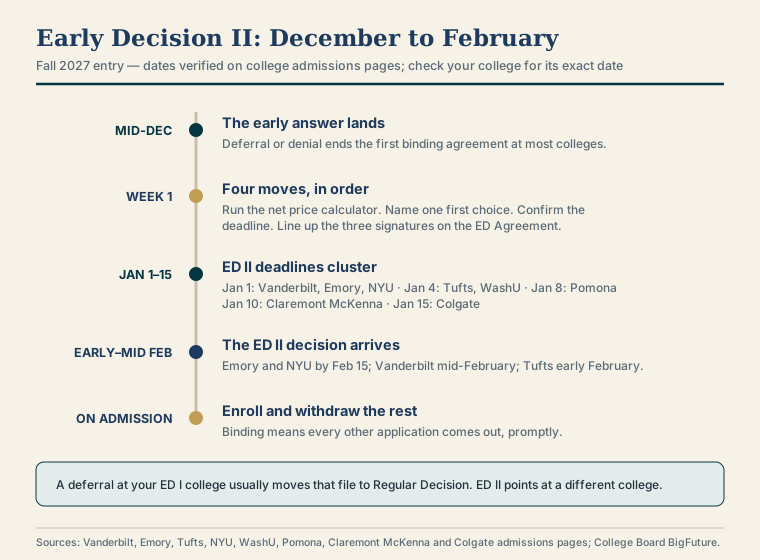
The calendar. ED II deadlines cluster between January 1 and January 15, with decisions arriving in early to mid-February. Three colleges close on January 1: Vanderbilt, Emory, and New York University — Emory and NYU promise decisions by February 15, and Vanderbilt says mid-February. Two close on January 4: Tufts, notifying in early February, and Washington University in St. Louis. Pomona closes on January 8, Claremont McKenna on January 10, and Colgate on January 15, each with February decisions. Read your college's own admissions page for its date.
The agreement. You sign an Early Decision Agreement. A parent or guardian signs. Your school counselor signs. Vanderbilt states the consequence directly: an admitted student must immediately withdraw applications to all other colleges and universities. One binding application at a time is the rule everywhere.
The aid clause. The College Board phrases the commitment with its condition attached: if the college accepts you and offers enough financial aid, you must go to that college. That clause is the release valve, and it belongs in your planning from the start. Run the college's net price calculator in December, save the result, and compare it with the preliminary aid offer in February. Families who need to weigh competing aid offers belong in Regular Decision, comparing packages through April — and our guide to common FAFSA and financial aid mistakes shows where aid files go wrong under deadline pressure.
The Deferral Question, Answered Carefully
A deferral at your ED I college usually moves your file into that college's Regular Decision pool. Tufts describes its deferred Early Decision applications as considered further with the Regular Decision pool, with admission no longer binding. Colgate states the boundary from the other side: students deferred under its Early Decision Option I will not be reconsidered under the Option II timetable. Wording varies by college, and your deferral letter governs your case.
The pattern across those policies is consistent. ED II after a deferral points at a different college. A denial closes the door at that college for the cycle as well. Either outcome frees you to make a new binding commitment elsewhere, and an ED II admission elsewhere then requires you to withdraw the deferred application you may still care about. Read that sentence twice before signing. The deferred college stays a live hope until the moment your ED II college says yes.
The Conversion Door
Some colleges let you convert an application already on file. Colgate allows students who filed Regular Decision applications by January 15 to change their status to Early Decision by filing an Early Decision Agreement any time before March 1, with notification within two to four weeks. Vanderbilt allows decision-plan changes through its MyAppVU portal up to two weeks after a plan's deadline, with the Early Decision Agreement required for a switch into Early Decision.
Conversion suits the senior who applied Regular Decision in December, then spent January certain. Certainty is the credential. A conversion signed to calm nerves in a household will feel very different in February, when it binds.
While the paperwork moves, keep the rest of the file strong. A well-built brag sheet behind your letters of recommendation helps recommenders write with fresh senior-year detail, and January college interviews test a specific set of qualities at colleges that offer them.
The Tactical Playbook
- Draft the ED II plan before December decisions land: one college, named, with a second choice held in reserve — and confirm its exact deadline and aid deadline on its own admissions page.
- Finish every Regular Decision application anyway. An ED II denial in February leaves the regular pool as your whole future.
- Run that college's net price calculator with a parent. Save the output. Decide the price your family can accept, in writing.
- Line up all three signatures on the Early Decision Agreement early: yours, a parent or guardian's, your counselor's.
- Read your deferral letter for its exact terms before signing anywhere else. Keep the deferred application alive until an ED II admission requires its withdrawal.
- Ask whether the college allows converting a Regular Decision application to ED II, and note the conversion deadline in your portal.
- Send first-semester senior grades promptly. January readers see them, and a strong fall helps a January file.
Choose the College You Would Sign For in October, Too
Mishka G.'s meeting worked because her family separated two questions. Where would she thrive studying the ocean? Which name sounded best at a dinner table? A binding round collapses those questions into one signature, so families do well to answer them separately, on paper, before December does the asking.
If your senior has a December deferral or denial on the desk and a January choice to make, schedule a free initial diagnostic consultation at meridianprep.com/contact. Our team evaluates the exact problem this guide describes: whether an ED II college fits the student's record and your family's price, whether the deadline leaves room to do it well, and what the signature would require you to give up. Bring the deferral letter. Leave with a decision you can defend in February.