Guide
College Interviews: What They're Actually Testing
Mishka G.'s family was split, and the split was the meeting.
She was aiming at marine science — UC San Diego, UC Santa Barbara, and the University of Washington. Her parents leaned toward out-of-state prestige, with Duke named among the options, while the family's own list of priorities also carried fit and proximity to home.
Her record was coherent: a 4.0 unweighted GPA, a 1420 SAT, president of an underwater robotics club, community-program volunteering at a major aquarium, coursework running through ASL 3, AP Biology, and AP Lang. Her counselor worked the tension with specifics: how national universities and liberal arts colleges differ for undergraduate research access, and UC Santa Cruz positioned as a relative safety for marine science, on program strength. What was being built in that room was the raw material of every strong interview answer — a student able to say, in her own words and with her own evidence, why a particular school fits work she has already done.
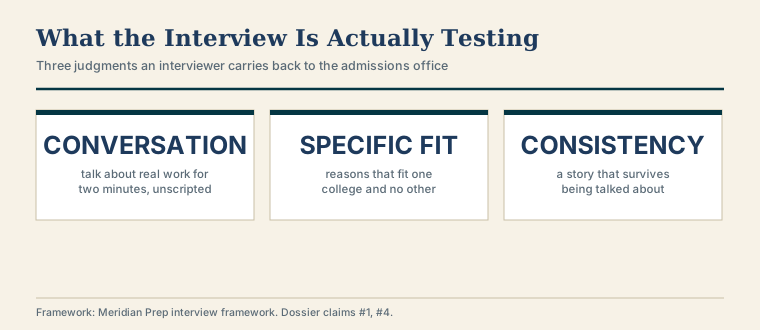
Families ask a reasonable question: what is this conversation for? By the time one is scheduled, the transcript, scores, and activities are already in the file. At Meridian, we teach that an interview tests three things: whether the student can converse like a future classmate, whether the fit they claim is specific, and whether the story in the file survives being told out loud. The wrong preparation treats the interview as a quiz, with answers memorized and facts about the university crammed. The three tests share one property: the material they examine accumulates over years, and it shows.
Whether there is an interview at all comes first. Many colleges offer none, and each college's own admissions page says whether it does. Where interviews exist, they divide into evaluative — a report goes back to the admissions office — and informational, run chiefly for the student's questions. The weight varies by college. A college's Common Data Set reports how much weight the interview carries among its admissions factors; a companion guide covers what the Common Data Set is and how families should read it.
Test One: Conversation
At colleges that offer interviews, alumni volunteers conduct most of them, and in our model the question underneath the conversation is plain: would this person contribute to a classroom and a community? The judgment forms from ordinary material:
- Can the student talk about something they care about, unscripted, at conversational length?
- Does the student ask anything back, or only answer?
- When the student does not know something, does curiosity arrive, or fluster?
What the list rewards is the quality the essays should already have shown — a real person, thinking in real time.
Test Two: Specific Fit
"Why us?" runs underneath most of the interview, asked directly or not. Weak answers name rankings, weather, and prestige — properties many colleges share. Strong answers are unreasonably specific:
- A particular program, lab, center, or course sequence, connected to work the student has already done
- A community or tradition the student can picture joining, with a reason rooted in their history
- A next step: what the student would actually do there in year one
Swapping in a different college's name should break it. Mishka G.'s file shows what such an answer is built from: an underwater robotics presidency, aquarium volunteering, and a counselor's question about undergraduate research access — the same discipline our guide to choosing a major lays out. Her targets and her parents' prestige lean belong to one conversation, and it belongs in the junior-year planning room, held with specifics, long before any interview room.
Test Three: Consistency
Interviewers often have little or no access to the applicant's file. The conversation still functions as a consistency check. A student whose application argues a community-centered story should be able to talk, unscripted, about the community and the work: what the Tuesday afternoons actually looked like, who showed up, what went wrong. Depth survives conversation. Padding does not.
Vanya D.'s personal statement was built from live courthouse observation — eviction court, and procedural detail she witnessed herself. A student with that material can answer follow-up questions for as long as an interviewer cares to ask; witnessed material behaves that way. The written version of that discipline is in Common App personal statement mistakes; the interview is where the same discipline gets tested out loud. The paper record underneath it is built the way our activity descriptions guide teaches — with counts attached.
This is why the best interview prep happened years earlier. Real involvement gives a student something to say. Night-before prep is organizing: knowing the load-bearing stories well enough to reach them from almost any question.
The Prep Framework That Works
Preparation starts with material. In our framework, three stories carry most interviews: the central project or commitment, a genuine failure or pivot, and the moment the intended direction clicked. The student rehearses telling them to a human, out loud, twice — the material known cold, every sentence left unscripted.
Two genuine questions for the interviewer change the room. Asking about their experience — what surprised them about the school, what they would do again — turns an interrogation into a conversation. It also tests the student's own fit, which is the interview's other job.
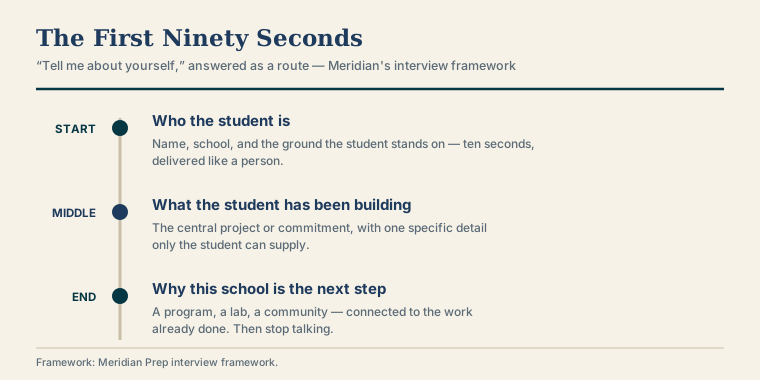
"Tell me about yourself" runs as a route: who the student is, what the student has been building, why this school is the next step. Our standard for it is ninety seconds, conversational, done.
Some colleges use recorded video responses or video essays. The skills transfer — specific, natural, structured — with camera practice added: the student records once, watches once, and fixes the framing, the light, the quiet room, and the backup plan for Wi-Fi.
At the close, the student thanks the interviewer, names one specific thing from the conversation that mattered, and sends a short thank-you note the same day that references it. Specific gratitude is rare enough to be remembered.
The Tactical Playbook
- Check each college's admissions page: whether it offers interviews, and whether they are evaluative or informational.
- Identify the three load-bearing stories; rehearse telling them aloud, twice, to a human.
- Memorize material — the stories and the specifics — and let sentences form in the room.
- Build the "why us" answer from one program, one community, one first-year step.
- Test every fit answer by swapping in another college's name; rewrite whatever survives the swap.
- Prepare two genuine questions about the interviewer's own experience.
- Rehearse the ninety-second route until it sounds like speech.
- For video formats: record once, watch once, fix framing, light, and sound.
- Bring no résumé to hand over unless asked.
- Ask no question the website answers in one click.
- Say nothing against a school, a teacher, or another college.
- Take informational interviews seriously; the weight varies by college, and in Meridian's view qualitative touchpoints are often where two equally qualified files separate.
- Send a specific thank-you note the same day.
- Parents: sit as the audience for two rehearsals, and leave the answers to the student.
Start With the Stories
An interview exposes whatever the file is actually made of, which makes it a diagnostic as much as a performance. Our team starts by identifying the stories a student can defend out loud — and the fit answers that still need building — while there is time to build them.
If interview season is approaching for your student, we invite your family to schedule a free initial diagnostic consultation at meridianprep.com/contact.