
Guide
Early Action vs. Early Decision vs. Restrictive Early Action: The Real Differences
Isaac C. came to his counselor in October of his junior year with two priorities in his file: stay close to home, and keep college affordable. An IB student from a cost-sensitive family, he was open to an out-of-state college only where strong scholarships or a full ride made the math work.
His counselor answered with a number. Twenty-five to thirty schools.
The list would span reach, target, and safety levels, built so admission and financial-aid offers could sit side by side in the spring and compete. The counselor used a concrete pairing: UCLA versus Cornell, a similar education at a very different price, with cost, major, and outcomes weighed together.
That architecture carries a quiet implication. A family that needs offers to compete has already made its early-round decision. Early Decision asks for the opposite habit: one college, one offer, accepted in December, with every other application withdrawn. For Isaac, an ED signature would dismantle the strategy his list was built to create.
The Promise Each Plan Makes
Early plans share a calendar and diverge on commitment. About 450 colleges offer an early admission plan, according to College Board BigFuture, and more than 300 offer Early Action. The agreements behind the names differ in ways that shape a family's finances for four years.
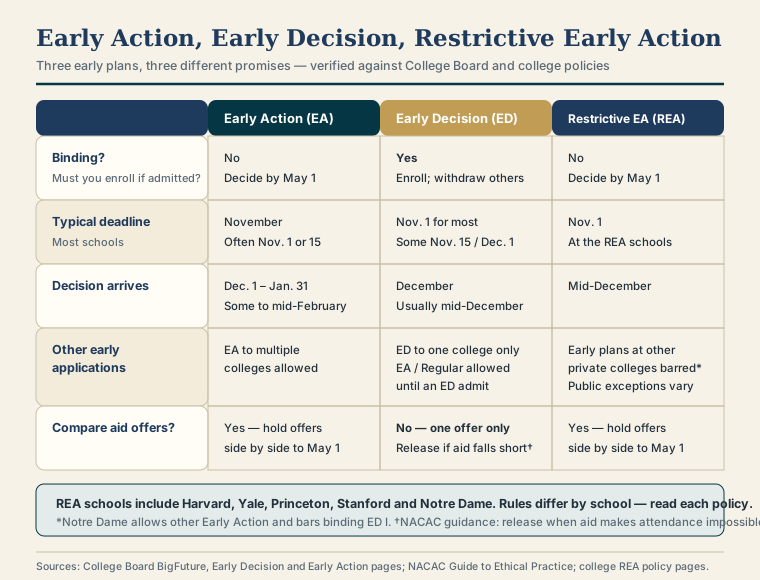
Early Action (EA) is non-binding. You apply in November, hear back early, and hold the offer until May 1. You may apply EA to multiple colleges, compare aid packages, and decline any offer.
Early Decision (ED) is binding. You apply to one college as your first choice, in an agreement signed by you, a parent, and your counselor. If the college admits you and offers an aid package considered adequate, you enroll, send a deposit well ahead of May 1, and withdraw every other application. You may apply EA or Regular Decision elsewhere while the ED file is pending. An ED acceptance ends that freedom on the spot.
Restrictive Early Action (REA), also called Single-Choice Early Action (SCEA), is non-binding with a restriction attached. You apply early to one private college and hold off on early applications to other private colleges while it is pending. You keep the May 1 reply date and the right to compare offers. Harvard, Yale, Princeton, Stanford, and Notre Dame offer versions of this plan, with related plans at Caltech and Georgetown. Each school writes its own exceptions, usually preserving non-binding early applications to public universities, rolling programs, and colleges outside the United States. Notre Dame runs the loosest version: applicants may apply Early Action elsewhere and face a bar only on binding Early Decision I. Read the specific college's policy page before filing anything else early.
The Calendar
Most ED applications are due November 1, with some schools set in mid-November or on December 1; colleges on a November 1 deadline usually respond in December. EA applications are generally due in November, with decisions between December 1 and January 31, and a smaller group waiting until mid-February. REA deadlines sit on November 1, with decisions in mid-December. Harvard states that pattern directly: apply by November 1, hear by mid-December, reply by May 1.
An early deadline pulls every task forward: essays, letters, and scores land in October. Settle the score call school by school — our guide to whether to submit or withhold test scores walks through the Common Data Set method.
Who Each Plan Actually Advantages
Colleges gain certainty from ED. An admitted ED student enrolls, so a college can build its class early with predictable yield. That certainty explains why colleges value the plan and why families perceive an admissions edge in the early pool.
Treat any edge with care. Early pools draw recruited athletes, legacy applicants, and students with polished applications. A raw gap between early and Regular Decision rates mixes pool composition with any benefit of timing. College-specific rates for this cycle [DATA NEEDED — verify in each college's Common Data Set or official release before citing a figure for a named school]. The mechanism holds without a borrowed number: ED helps a college most directly, an aid-secure student with one clear first choice plausibly, and a cost-sensitive family least of all.
EA rewards the organized student: a strong file finished by November earns an early answer and a calmer winter, with every option preserved. REA favors a student with a genuine first choice among its small group of colleges who still needs to compare prices in the spring. The restriction costs other private early applications for one round. The May 1 freedom survives.
The Financial-Aid Trap Inside ED
Here is the sentence families skim past. Under ED, you receive one aid offer, with no competing offers in hand.
College Board states the drawback plainly: ED students receive admission and aid offers at the same time, and they will be unable to compare aid offers from other colleges. Comparison is the leverage Isaac's list was designed to create. An appeal grounded in a peer college's better offer requires that offer to exist. ED removes the evidence before the conversation begins.
A release clause exists, with an exact shape. NACAC's Guide to Ethical Practice in College Admission advises colleges to release an ED applicant who is denied, deferred to a different date, offered a different program, or offered an aid award that fails to make attendance possible. Standard agreement language echoes that test: a student who applied for aid and receives an award leaving attendance impossible may decline and be released.
Read the limits inside that protection. The clause turns on impossibility, measured against the college's award, after you complete the aid process and pursue reconsideration. A disappointing package, or a cheaper offer you imagine another college might have made, sits outside the test. The exit arrives late, after other deadlines have passed. Run the college's net price calculator before you apply; treat a wide gap from your budget as a warning. Our guide to FAFSA and financial-aid mistakes that cost families money covers errors that shrink offers, and separated households should read our guide to FAFSA rules for divorced parents before an early deadline locks in an aid picture.
A second door opens in winter. Early Decision II carries the same binding commitment on a January timeline, with decisions in February — and the same aid logic: one offer, no comparison, the same release standard.
The Tactical Playbook
- [ ] Write your aid position in one sentence: the annual amount you can pay, and whether comparing offers is essential. If comparison is essential, rule out ED.
- [ ] Run the net price calculator for any ED college. Save the estimate; compare it with your budget.
- [ ] Classify every college by plan — EA, ED, REA/SCEA, Regular Decision — from its own admissions page. Record each deadline and decision date.
- [ ] For an REA college, copy its restriction language verbatim. Check allowed exceptions, especially public universities and scholarship deadlines.
- [ ] Apply ED to one college only. Keep EA and Regular Decision files moving while it is pending; prepare to withdraw them after an ED acceptance.
- [ ] Complete the FAFSA and, where required, the CSS Profile by the early aid deadlines. The release clause protects families who applied for aid.
- [ ] Build the comparison list anyway: 25–30 schools across reach, target, safety.
- [ ] Calendar May 1. EA and REA admits hold their choice until then. ED admits follow the deposit schedule they signed.
Choose the Plan That Keeps Your Word Affordable
Isaac's list works because every part serves the family's priorities: proximity where possible, scholarships where distance is involved, offers in competition before a decision. An early plan deserves the same test. Pick the plan whose promise matches how your family will actually pay.
If you are weighing an ED signature against a need to compare aid, bring that tension to a free initial diagnostic consultation with Meridian. We review your list, your early-plan choices, and the aid math behind each one. Book your consultation at meridianprep.com/contact.