
Guide
FAFSA When Parents Are Divorced or Separated: Whose Income Counts
She arrived with the answer already settled. Her daughter lived with her most of the year, in her house, on her school route. So she would file the FAFSA. She had the tax return in a folder and a pen in her hand.
Her counselor asked a different question: who paid for the year? The rent, yes. Then the car insurance, the health premiums, the orthodontist, the summer program deposit. Money had crossed between two households all year, and the parent who covered the larger share lived across town.
That scene repeats in initial meetings every fall. Parents walk in certain that residence decides the form. Since the 2024–25 cycle, residence decides very little. Our broader guide to FAFSA mistakes that cost families eligibility flags the wrong contributor as a recurring error; this guide gives the full rule.
Support Replaced Residence
A contributor is any person required to provide information on the FAFSA. Each contributor needs a StudentAid.gov account, and each must consent to the direct transfer of federal tax information from the IRS. A missing consent makes the student ineligible for federal aid.
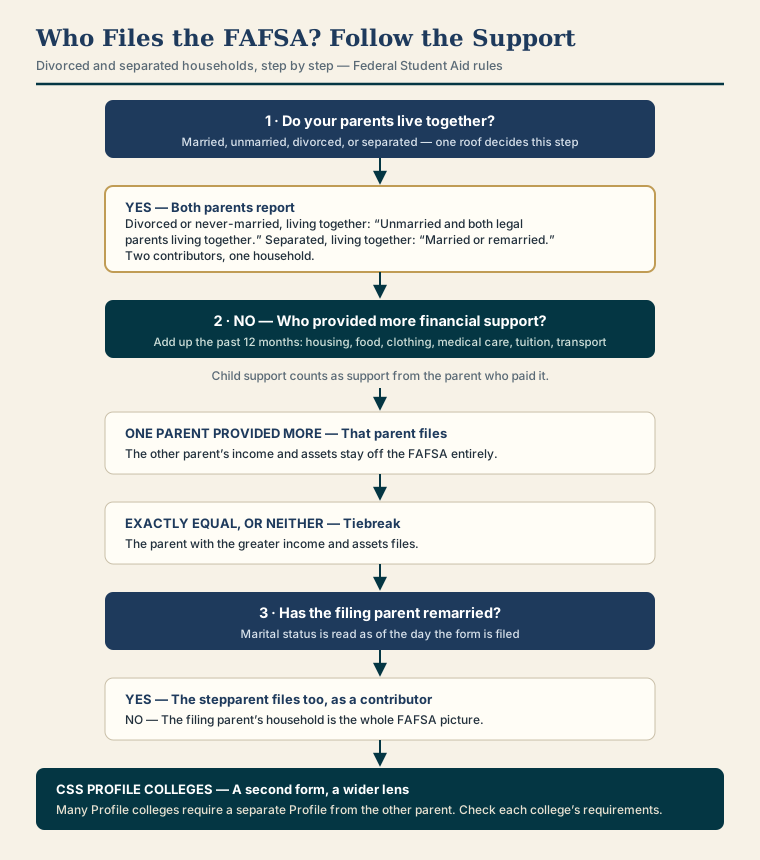
For divorced or separated parents who live apart, Federal Student Aid names the contributor by support: report the parent who provided the greater portion of the student's financial support during the past 12 months, even if the student does not live with that parent. Support means money spent on the student's life — housing, food, clothing, medical and dental care, tuition, transportation. Add up both households before anyone opens the form.
An exact tie has a tiebreak. If both parents provided an exactly equal amount of support, or if neither parent supports the student financially, report the parent with the greater income and assets.
Living arrangements still matter at one step. Parents who share a home report together, and both parents' information goes on the form. The status label depends on the parents' history. Divorced or never-married parents living together select "Unmarried and both legal parents living together." Separated parents living together select "Married or remarried." Parents count as separated when they are legally separated under state law, or when they are legally married but have chosen to live separate lives — including living in separate households — as though they were not married. Separate addresses alone do not settle it: a couple still living as a married couple counts as married on the FAFSA, even across two households.
Federal Student Aid built a tool for the edge cases. The "Who's My FAFSA Parent?" wizard at studentaid.gov walks a family through a short set of questions and names the required contributors. Federal Student Aid says the tool takes most people less than five minutes and requires no account.
Working the Support Test, Line by Line
Run the test as a worksheet, one category at a time. For each parent, list what that parent paid over the past 12 months across the categories above. Credit child support to the parent who paid it. Add each column. The larger total names the contributor, and the comparison holds even when the student sleeps most nights at the other parent's home.
Two results surprise families. A parent can lead the test through a few large categories — health premiums, tuition, a summer program deposit. And a near tie still produces one name: the tiebreak applies only at exact equality, or when neither parent provided support, and it sends the form to the parent with the greater income and assets.
Child Support Cuts Both Ways
Child support enters this calculation twice, in two different roles, and families routinely merge them.
First, child support helps decide who files. Federal guidance counts child support as financial support provided by the parent who pays it. A parent who pays substantial support across the year may be the reporting parent, even when the student sleeps at the other parent's home most nights.
Second, child support received appears on the form as an asset. Under current rules, the parent who received child support reports the total received during the last complete calendar year in the asset section. Earlier versions of the FAFSA treated that money as untaxed income; the Simplification Act moved it to assets.
Verification turns records into evidence. A college financial aid office can ask the reporting household to document both roles of child support: the order that set the amount, the payment history showing what moved during the year, and bank statements showing receipt. Families who keep those papers in one folder answer from records. Reconstructing a year of payments from memory invites delays while an aid office waits for proof.
Remarriage Adds a Contributor
The support test names one parent. Marriage can add a second name.
If the reporting parent has remarried as of the day the FAFSA is filed, that parent's spouse — the student's stepparent — is also a contributor. The stepparent provides information, consents to the IRS transfer, and signs. This holds regardless of any agreement between the spouses about college costs.
The other parent's position stays simple on the FAFSA: a parent who fails the support test, and whose household the form never opens, reports nothing. That parent's income and assets stay off the application. Hold that fact loosely, though. A second form may be waiting.
The CSS Profile Asks About Both Households
Several hundred colleges require the CSS Profile, the College Board's application for institutional aid, alongside the FAFSA. The Profile reaches further, and divorced households feel the difference first.
Where a college requires it, the other parent completes a separate CSS Profile through a College Board account of their own. The College Board defines that noncustodial parent as the parent who does not provide the majority of the student's financial support — the mirror image of the FAFSA test. Requirements vary by college, so check each school's financial aid page and the College Board's participating institutions list. Colleges publish their aid behavior in the Common Data Set as well; our guide to what the Common Data Set is and how families should read it shows where those numbers live.
Start that conversation early. The other parent needs time to create an account, gather tax records, and meet a Profile deadline.
Deadlines compound the problem. Profile deadlines often sit beside application deadlines, which is why divorced households benefit from reading our comparison of early action and early decision before the calendar fills.
The Tactical Playbook
- Run the "Who's My FAFSA Parent?" wizard at studentaid.gov before anyone opens the form.
- Reconstruct the past 12 months of support, parent by parent: housing, food, clothing, medical care, tuition, transportation.
- Credit child support to the parent who paid it when you run the support test.
- Apply the tiebreak only on a true tie: equal support, or support from neither parent, sends the form to the parent with the greater income and assets.
- Report child support received as an asset — the total from the last complete calendar year, in the reporting parent's asset section.
- Invite the stepparent early if the reporting parent has remarried; that spouse needs an account, IRS consent, and a signature.
- Check every college on the list for a CSS Profile requirement and a noncustodial Profile requirement; record each deadline separately.
- Keep support orders, payment records, and bank statements in one folder for verification.
- File the FAFSA with the reporting parent only. Leave the other parent's finances for the colleges that ask through the Profile.
A Last Word on Certainty
The mother with the folder had done the arithmetic of daily life: school nights, dinners, drives. The form asked for a different arithmetic, and the two produced different names. She left with the right contributor identified and a records folder to build.
If your household runs on two addresses, schedule a free initial diagnostic consultation at meridianprep.com/contact. Our team evaluates the exact problem this guide describes: which parent reports, which colleges will ask the other parent for a Profile, and whether your deadlines leave room to gather what each form requires. Bring both households' paperwork. The support test rewards the family that can show its math.